
Generative AI in eCommerce: Key Use Cases and Benefits

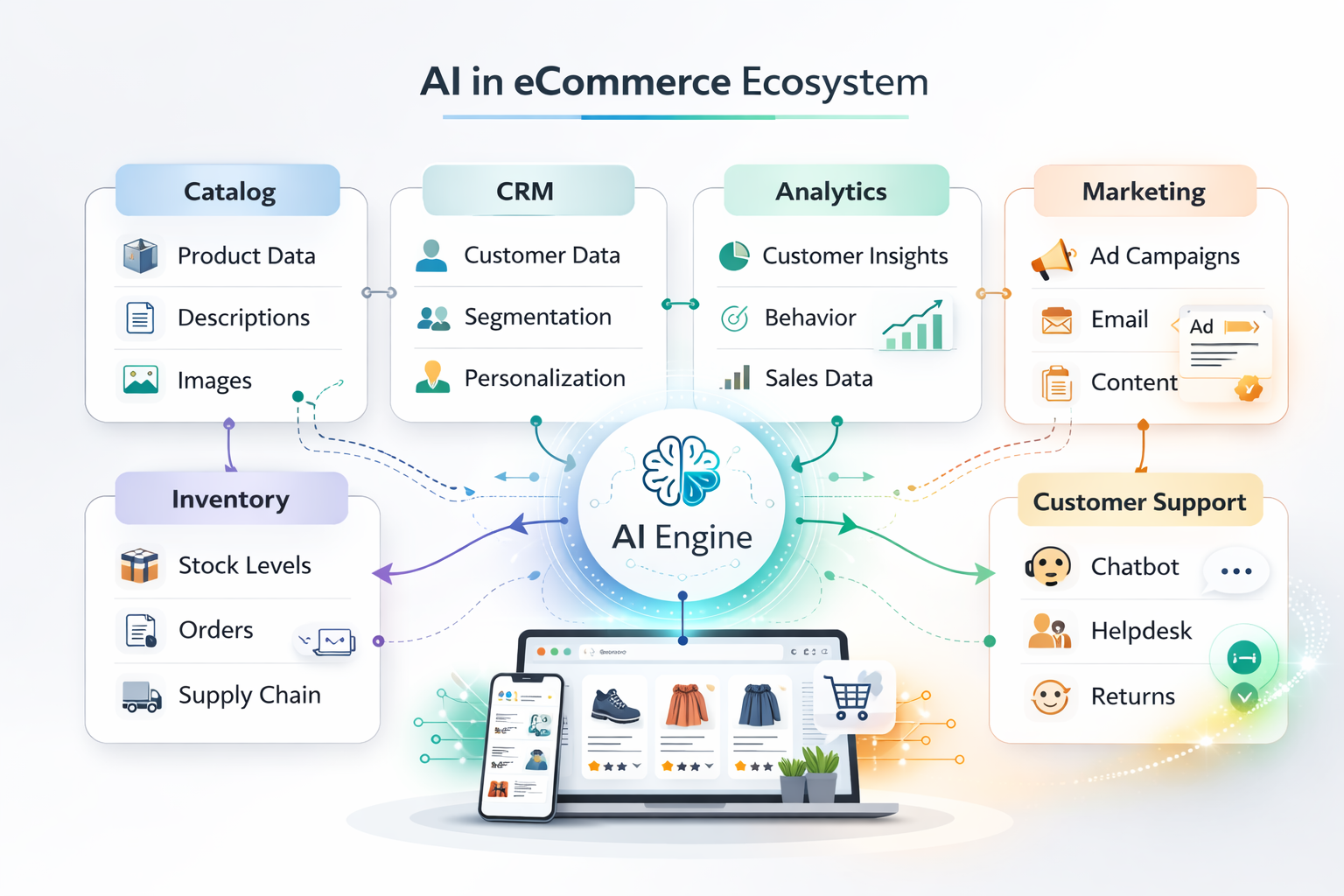
Generative AI is transforming the landscape of eCommerce. The use of chatbots as an experimental integration is now commonplace throughout the entire digital retail ecosystem — including how product content is developed, how customers are supported, how products are marketed, and even how merchandise is strategized.
For digital retailers, generative AI’s true value isn’t in novelty, but rather in scalability. This incredible tool enables teams to create, customize, and refine items at previously unattainable speeds without having to expand their employee base significantly. When used correctly, the output of this technology results in increased efficiency, revenue, and improved customer experience at the same time.
Rapidly Generate Product Content through the use of Generative AI
One of the quickest ways generative AI can be used in eCommerce is for product content generation. Many eCommerce sites have anywhere from thousands to millions of SKUs they’ll manage, creating SEO-friendly and compelling product descriptions for these large catalogs of items is time-consuming and labor-intensive.
With generative AI, product titles, descriptions (both long-form and short-form), feature lists, size guides, and meta descriptions can be generated in seconds and at scale. Furthermore, generative AI allows for tone/structure standardization across the vast assortment of products, which provides for improved brand consistency. In addition, supplier data can get cleaned/augmented to provide customer-friendly versions of raw specifications.
The outcome will be faster new product introduction cycles, richer product pages, and an increased likelihood that customers will find your products via the search engines.
Richer Personalized Experiences Across Each Stage of the Customer Journey
Historically, personalization has been a source of competitive differentiation in the eCommerce marketplace. Traditionally, it has focused on the recommendation of products. Today generative AI expands upon this through the generation of personalized content.
Rather than using the same product description for everyone, retailers can create tailored messaging based upon customer behavior’s, their previous purchases or browsing activity, so that beginning/novice purchasers will receive an explanatory product description and expert purchasers will receive more technical detail. Email marketing messages, landing pages, and promotional content will all dynamically adapt to user intent.
This level of personalization will not only provide customers with richer engagement but will also increase conversions dramatically since customers will perceive themselves as understood rather than simply targeted.
AI Shopping Assistants and Conversational Commerce
Search boxes are turning into communications; with generative artificial intelligence (AI), customers can explain their requirements in natural language: “I want a waterproof winter jacket to go hiking, $200 or less.” Generative AI provides contextual recommendations along with details describing why those items are appropriate for that particular need. Businesses investing in advanced gen AI development services are enabling these highly personalized, intent-driven shopping experiences at scale.
AI shopping assistants can also ask probing questions regarding customer needs, contrast products being recommended, summarize customer reviews of items within the recommended parameters, and thus help customers make a buying decision by dramatically decreasing friction, shortening the length of time it takes for customers to purchase something, and building trust in customers’ purchasing decisions.
As the sophistication of conversational commerce matures, it is becoming increasingly less about chat widget type of assistance and more about offering intelligent purchase guidance embedded in the actual shopping experience.
Enhancing Customer Service
Generative AI has a measurable impact in the area of Customer Service. Generative AI can assist with generating responses based on previous customer interactions, summarizing customer histories, clarifying policy guidelines, and assisting in the process of resolving customer service issues in a more timely manner.
Additionally, AI virtual assistants can be connected to Order Management Systems and Knowledge Bases to assist with handling frequently asked questions such as order status, processing returns, and exchanging items. The reduction in response times and the lowered operating costs provide better levels of customer satisfaction — if not increased customer satisfaction — by utilizing generative AI instead of eliminating what would have been required to provide those services to customers. Rather than replace customer service teams, generative AI will be used to increase the output of customer service teams by allowing customer service representatives to focus on more complicated or emotionally charged issues
Fast-tracking Creative Production and Marketing
The velocity of content creation across many marketing departments can be challenging. Each campaign must have many variations (ad copy, products, headlines) and localized versions. Generative AI will improve the rate at which assets are created by generating multiple creative versions of the same concept in real-time.
Because of this, there are faster A/B tests/experiments. Instead of taking time to discuss creatively internally, they can take variations to market and let performance data inform creative direction. The result: Greater efficiency than before and a competitive advantage.
The agility offered by generative AI (in both retail media and performance marketing) positively impacts return on ad spend.
Enriching Discovery and Merchandising Currently
Wayfarer engages users through marketing and content, but it also enhances users’ ability to shop at a store and buy products with smarter merchandising. It uses generative AI to create buying guides, recommend a bundle, generate the narrative for “Shop the Look,” and summarize customer reviews to help customers find the material quickly and helpfully on product pages. Generating AI will provide a decision-support environment on product pages, where users are not just browsing products on display; instead, they will be directed to help them make their purchase decisions.
In addition to generating AI having advantages with helping merchandising teams identify gaps in product selections, it will also generate analytics and first-party data to identify seasonal opportunities for new product assortments, as well as how to develop cross-sell strategies.
Business Advantages of Generative Artificial Intelligence in eCommerce
The advantages of generative artificial intelligence in eCommerce generally revolve around three major areas of focus: revenue enhancement, streamlined operations, and enhanced customer experience.
Revenue grows via enhanced product detail (better information on products), improved ability to personalize offerings, and more effective marketing methods. Streamlined operations result from a significant decrease in the manual effort required to generate content, respond to customer inquiries, and develop marketing campaigns. Customer experience improves as customer interactions become faster, easier to understand, and more relevant.
Additionally, generative AI allows retailers to more effectively utilize their own first-party data. Catalog data, customer behavioural information, product reviews, and customer support logs all can serve as inputs for unique customer experiences that retailers’ competitors will have trouble replicating.
Guidelines for Implementation of Generative AI Technology
Generative AI technology has the potential to greatly transform the way companies market and sell products; however, it will require careful implementation to ensure an accurate, trusted experience with e-commerce. Therefore, it is necessary to build generative AI technologies upon real-time data for the products, their prices, their inventory, and the company policies to prevent misinformation about them.
Human beings will continue to play an important role in generating content for high-profile products (i.e., high-traffic product pages and regulated products). Companies should implement governance frameworks that establish their tone, guidelines, compliance, and review processes in order to maintain brand credibility. Also, retailers adopting AI as a foundational, overall, holistic strategic capability provide the best results.
Toward a Future of Digital Commerce that is AI-Native
As the next stage of generative AI continues to develop in eCommerce, we will see the integration of task completion into the AI’s ability to generate content. Customers will not only have assistance with locating products but also be assisted by AI in comparing, selecting, bundling, and completing purchases.
As digital storefronts begin evolve, AI will become an intelligent layer that will connect data, content, and the intent of consumers in real-time. Retailers that are willing to adopt this trend early on will be able to provide consumers with faster, smarter, more humanised shopping experiences.
Generative AI has moved past being an experimental technology used for eCommerce and is quickly becoming the underpinning of the modern digital retailer.
The Author


No Comment