
AI Code Refactoring: How It Works, What It Handles, and How to Do It Safely

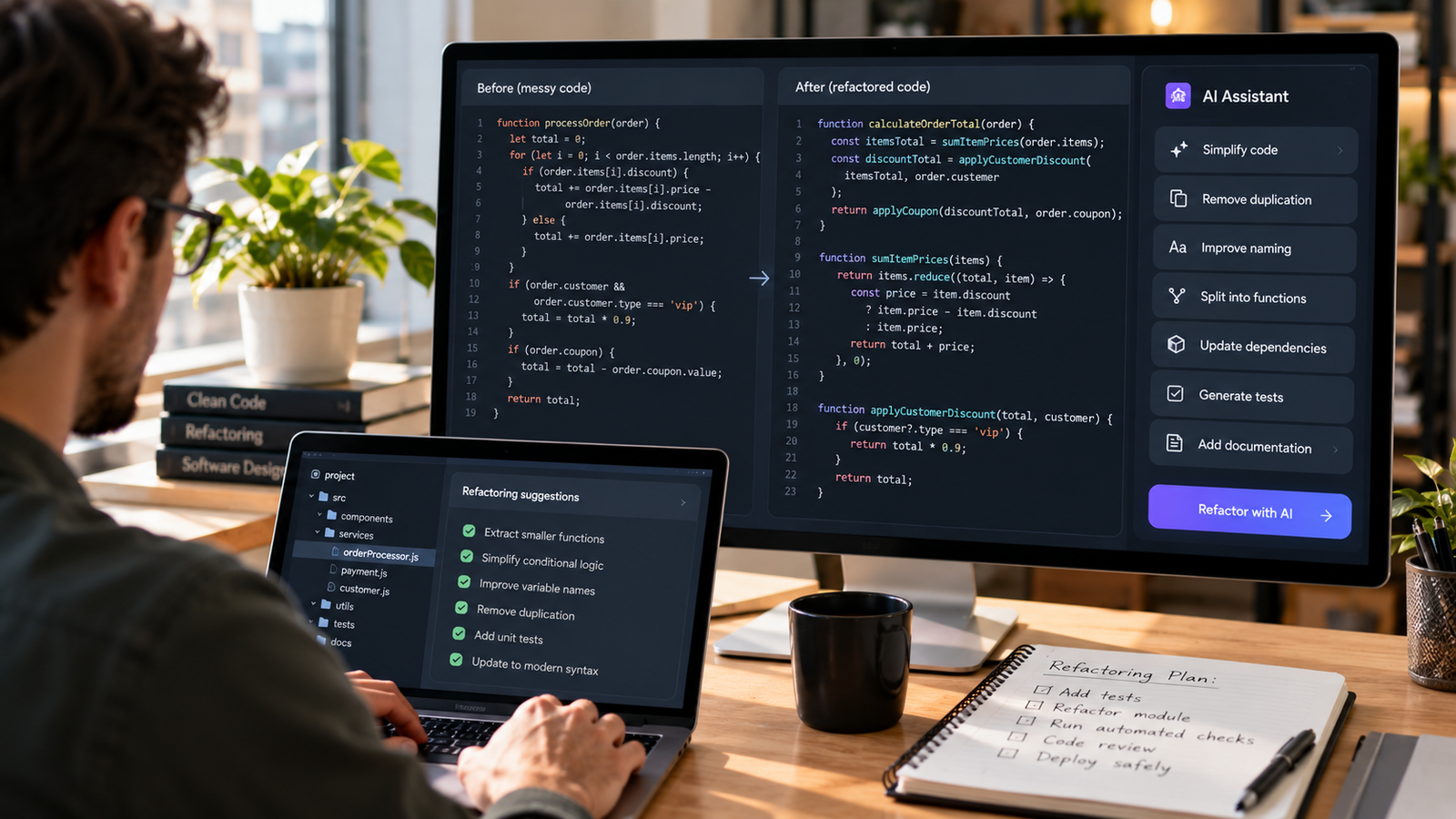
There are definitely not many instances when software remains unblemished after the first version is out. This happens because, with the passage of time, new features emerge, requirements change, dependencies become outdated and temporary patches quickly become permanent fixes. At some point, the development process comes to a halt since engineers spend a lot of time analyzing and circumventing the old code instead of creating something new.
The problem can be solved with the help of refactoring, which can enhance the internal structure of the software without purposely changing its external behaviour. Artificial intelligence can speed up the process of refactoring by investigating the code, providing recommendations, substituting code parts with appropriate fragments and simplifying technical transformation procedures.
Nevertheless, using AI for refactoring is not the same as just outsourcing code cleaning to the AI assistant. An inattentive approach can lead to the emergence of new bugs, new security threats, and other problems related to the lack of a proper architectural approach.
The solution lies in utilizing the speed of AI combined with the control of engineers.
What Is AI Code Refactoring?
Simply put, AI code refactoring is the application of AI tools in the process of inspecting and rewriting existing source code while keeping its main purpose intact.
Traditional refactoring generally relies on programmers finding code smells, duplication, big functions, over-complicated dependencies, and unclear structure manually.
With modern AI coding instruments, it’s possible to surprise programmers with how much natural language processing and understanding can bring in the process of interpreting code snippets of considerable size. An AI assisted development partner can also help integrate these tools into a structured refactoring process while keeping engineering oversight in place.
For instance, the AI assistant can spot a specific 200-line function dealing with validation, database operations, and formatting and advise breaking it down into smaller functions with simpler purposes.
AI Code Refactoring Process
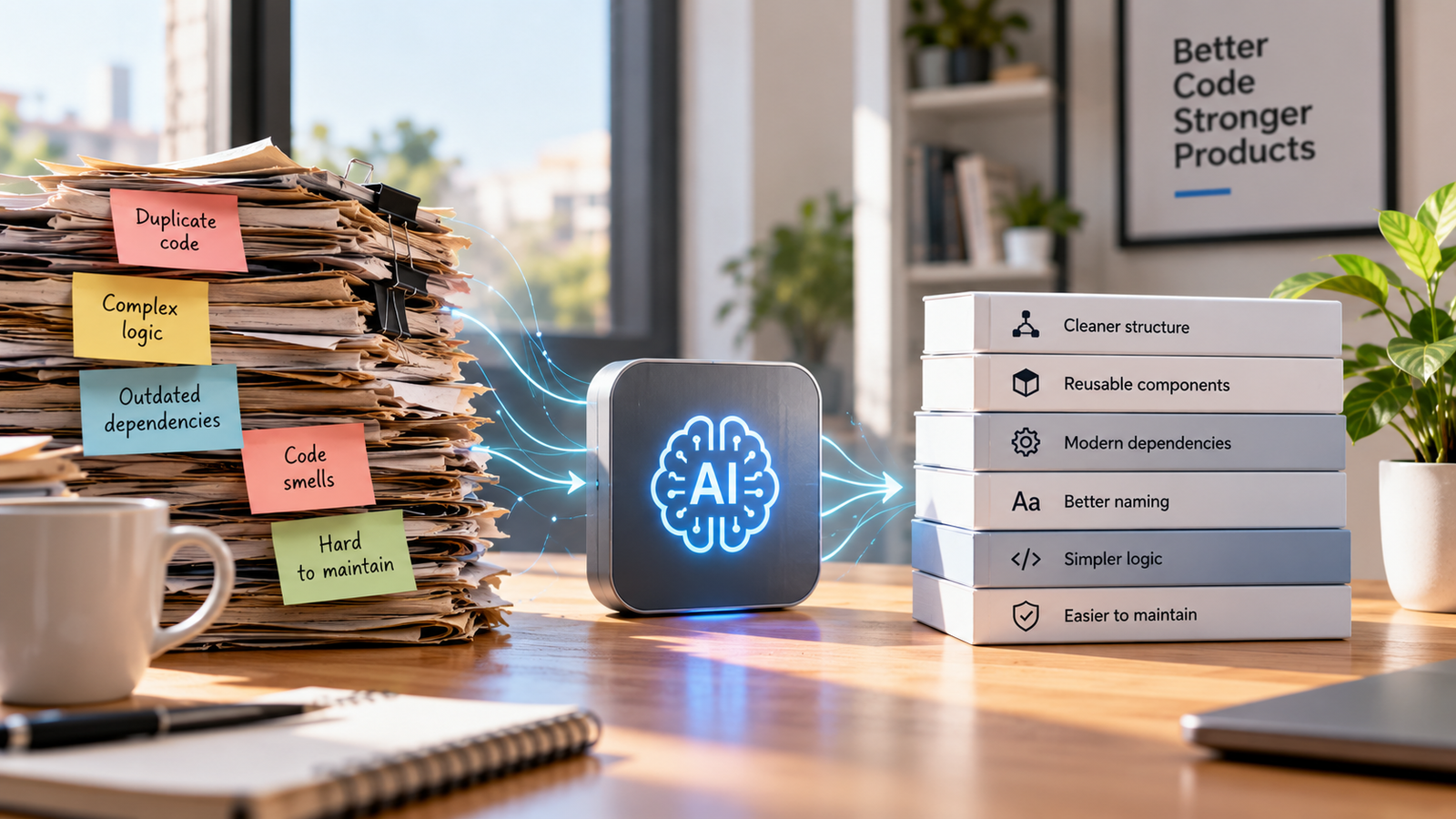
This process generally begins with gathering context about the code being analyzed. The AI tool processes the designated code, which can include several different items (like code snippets, files, modules, tests, documentation and sometimes larger catalogues).
The system attempts to identify patterns that could be improved upon, such as the case with copy-pasted code, overly complicated processes, poor naming conventions, redundant complexity, obsolete programming interfaces and so on.
Developers can do more than just ask for general improvements to the code. For instance, the engineer can instruct the AI of the need to update the library or migrate a module to a new version of the framework.
As a result of running the AI software, the process proposes the code changes, which should be categorized in accordance with the engineering processes that apply to conventional human-coded solutions.
What is AI Refactoring Capable Of?
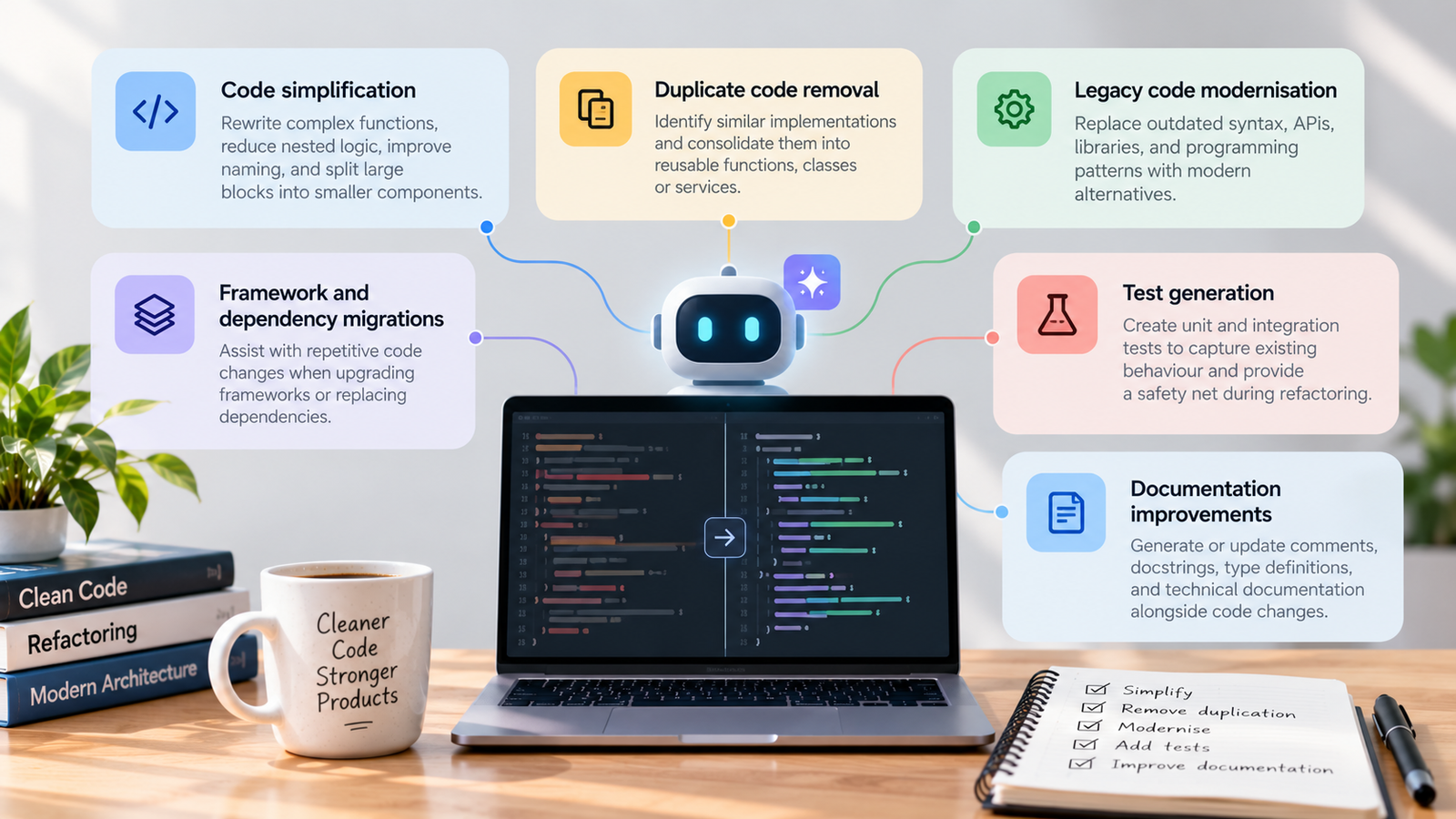
As long as there is a repetitive refactoring effort that leads to a clear target state, AI comes in handy.
Code simplification. AI can simplify overly complex functions, eliminate nested conditions and improve naming as well divide large pieces of logic into smaller building blocks.
Removing duplicate code. Duplicate code in projects can be found and merged into common functions, classes or services to create reusable code.
Legacy code upgrading. AI instruments can be used to replace outdated syntax, API, libraries, and programming patterns with more modern languages or technology.
Framework and dependency migrations. The use of AI can minimize changes that must be made to complete framework upgrades or other dependencies.
Test creation. AI can prepare the unit or integration tests that would confirm the expected code functionality prior to modifying some sensitive code, making sure that tests can help with the refactoring process.
Documentation improvement. AI can add or update comments, docstrings, type definitions or technical documentation along with the code changes. At the same time, the technology cannot be relied upon completely when refactoring is performed based on undocumented business rules or complex architectural solutions.
Why AI Refactoring Can Be Risky
The primary danger is that the produced code may seem accurate even though it will change the code’s functioning in surprising ways that are hard to spot right away.
Take billing software as an example. It may have many conditions accumulated over years of development, and thus simplifying the code may cause some conditions to be missed.
Another aspect to be taken into account is security. Refactoring security mechanisms requires more thorough checks. That’s because small changes can lead to vulnerabilities.
Additionally, the limitation of the amount of context available should be acknowledged. AI may know how one particular file has to be modified but miss out on other dependencies, integrations, constraints, and assumptions.
Due to all the above, the code being compiled can’t be a measure of AI-based refactoring success.
How to Refactor Code in a Safe Manner With AI
To ensure a safe process of AI-enabled refactoring, it is essential to prepare first.
First, create a standard model. Previous unit or integration tests, testing used, and other requirements should provide full information on the implementation. In case of lack of coverage, crucial user scenarios should be tested before making major changes.
Next, users should clearly define their goals. It is very difficult to state the goal of “improving the whole codebase”, but if the goal is “removing payment management from the service without changing the work of API” it will be much easier to achieve it.
Then, changes should be made step by step. Smaller pull requests are much easier to check than bigger pull requests.
Each step requires running automated testing, static analysis, linter, dependency analysis, and security checks. Performance-critical systems may need benchmarking.
Finally, human verification is important. Engineers need to evaluate whether the code follows requirements, architecture, and company policies and if it fits into the architecture.
As for legacy applications, companies should think about using code auditing services before the implementation of AI.
Ending remarks
Artificial intelligence enhances the speed and efficiency of code refactoring by helping software developers to ease complicated logic, upgrade legacy systems, eliminate redundancy, and create tests. Nonetheless, it is best used as an engineering assistant rather than an independent substitute for developers. Having well-defined refactoring objectives, extensive testing coverage, manual code verification, and careful implementation allows corporations to use AI to cut technical liability while keeping software reliable, protected, and easy to maintain.
The Author






No Comment