
The Role of IoT in Modern Grocery Delivery Applications

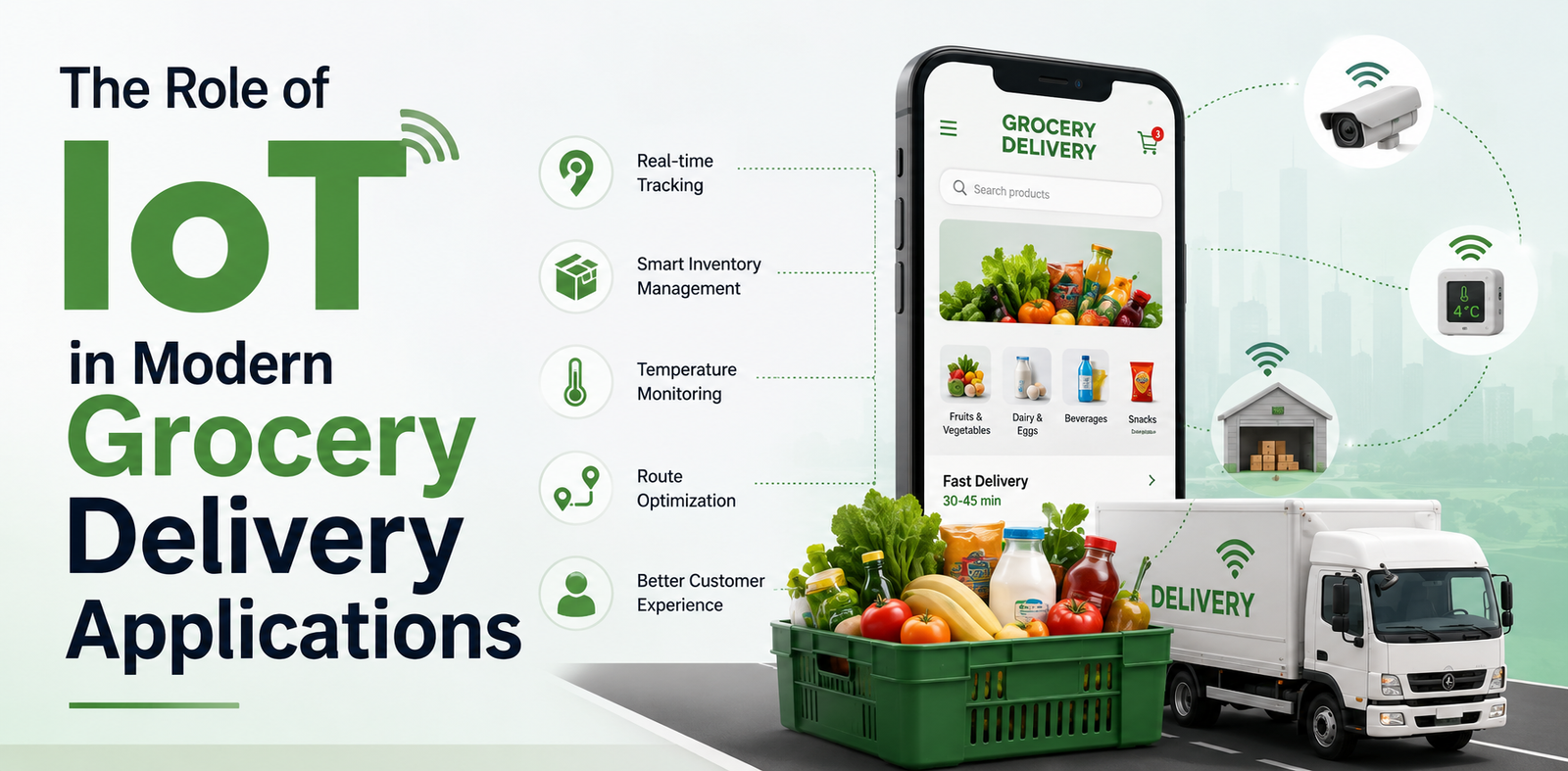
Technological innovations have become prevalent in the grocery industry to improve customer experience, streamline the operation process, and increase the efficiency of deliveries. The technology that has been adopted by many companies in the grocery industry today is IoT, which has become an important part of grocery platforms, as it links physical objects, sensors, delivery cars, storage facilities, and software.
IoT may enable grocery businesses to track temperatures of products, manage delivery vehicles, and control smart warehouses, among other things. Such capabilities may help business owners make better decisions and offer their customers more efficient delivery services.
For companies planning to enter the digital grocery market, understanding the potential of IoT in modern grocery delivery app development can help create more intelligent and scalable business models.
What Is IoT in Grocery Delivery?
The Internet of Things is a name that refers to a set of devices that are internet-enabled and able to collect, transmit, and analyze data. Examples of such devices can be sensors for temperature readings, RFID tagging, GPS tagging, intelligent shelves, barcode scanning devices, sensors in the warehouse, and delivery trucks.
The devices continuously create information that can then be transmitted to software platforms. The businesses can use the information for such activities as inventory tracking, delivery performance analysis, product quality maintenance, and operations improvement.
For instance, the temperature sensor within the refrigerated delivery truck can help in monitoring the delivery of goods. In case there is an increase in temperatures beyond the set threshold, the operations team will be alerted.
Why IoT Matters for Grocery Delivery Businesses
The grocery delivery app development company often depends on manual inventory checks, physical inspections, and separate tracking systems. These approaches can create delays and data inconsistencies.
IoT creates a connected ecosystem where physical operations and digital platforms communicate continuously.
Key advantages include the following:
- Real-time inventory visibility
- Better product quality monitoring
- Improved delivery tracking
- Reduced food waste
- Automated stock monitoring
- Better warehouse management
- Improved route efficiency
- Faster operational decision-making
- Enhanced customer experiences
- Reduced manual intervention
These benefits make connected technology increasingly valuable for grocery retailers and delivery startups.
Major Applications of IoT in Grocery Delivery
1. Smart Inventory Management
In grocery businesses, it is important to ensure inventory accuracy because customers will have a higher expectation of having the products that are shown on the application available for purchase.
With the help of IoT shelves, RFID tags, barcodes, and sensors, inventory movement can be automatically tracked. Whenever there are products purchased, moved, or replenished, this can be automatically synced with the inventory system.
This reduces manual stock counting and helps businesses identify low-stock products more quickly.
2. Temperature Monitoring
Temperature-dependent items like dairy, meat, frozen food, and some fresh food need controlled storage and transport.
The IoT temperature sensor will keep monitoring the temperature within the warehouse, refrigerators, and transporters. In case of temperatures beyond an acceptable limit, automatic alerts can be set for the employees.
It helps to ensure the quality of the products and avoid losses due to improper storage or transport.
3. Real-Time Delivery Tracking
GPS-enabled IoT devices can provide businesses with accurate information about delivery vehicles.
Operations teams can monitor:
- Vehicle location
- Delivery progress
- Estimated arrival times
- Route deviations
- Vehicle status
- Delivery delays
This information can also support customer-facing tracking features, allowing customers to receive more accurate delivery updates.
4. Smart Warehouses
IoT technology can transform traditional warehouses into connected environments.
Sensors can monitor storage conditions, product movement, equipment activity, and warehouse occupancy. Connected systems can identify operational inefficiencies and provide managers with real-time information.
Businesses can combine IoT with automation and robotics to improve picking, packing, and order fulfillment processes.
5. Product Expiry Monitoring
Food waste is a significant concern for grocery businesses. IoT-enabled tracking can help businesses monitor product batches and expiration dates.
When products approach their expiration dates, the system can generate alerts. Businesses can then prioritize those products for promotions, faster fulfillment, or appropriate inventory rotation.
This approach can reduce unnecessary waste and protect profit margins.
IoT and Customer Experience
IoT does not only improve back-office operations. It can also influence the customer experience.
Customers increasingly expect accurate product availability, fast deliveries, transparent order tracking, and quality assurance.
Connected devices can provide the information needed to support these expectations.
For example, a customer ordering frozen products can receive an accurate delivery estimate while the business continuously monitors the vehicle’s temperature. Similarly, real-time inventory synchronization can prevent customers from ordering products that are already unavailable.
This creates greater transparency and can improve customer confidence.
IoT-Powered Route Optimization
Efficiency in delivery is directly linked to the profitability of the grocery business because fuel, traffic jam, unsuccessful deliveries, and route inefficiency lead to increased costs of operations.
GPS devices that are supported by IoT can collect the location and motion data of vehicles. In combination with maps and intelligent algorithms, this data could be used for optimizing the delivery routes.
Efficient routes could be identified, and delivery could be monitored and reacted to in case of unforeseen problems like traffic jam or diversion from the planned route.
For big companies, small improvements of delivery efficiency could result in considerable savings in operations.
Combining IoT With AI and Machine Learning
The real power of the Internet of Things is best seen in the combination of IoT with artificial intelligence and machine learning.
IoT creates huge amounts of information about the operations, which in turn can be processed using artificial intelligence and machine learning.
For instance, companies can use past sales data together with IoT data about inventory to predict future demand for products. Likewise, delivery data can be used to recognize regular problems and optimize routes.
Potential AI and IoT applications include:
- Predictive inventory replenishment
- Demand forecasting
- Intelligent route optimization
- Automated anomaly detection
- Predictive equipment maintenance
- Personalized customer recommendations
- Warehouse optimization
This combination can help grocery businesses move from reactive management toward proactive operations.
IoT Architecture for Grocery Delivery Platforms
A successful IoT-powered grocery platform generally includes several interconnected layers.
IoT Devices
Sensors, RFID tags, GPS trackers, smart shelves, barcode scanners, and other connected devices collect operational information.
Connectivity Layer
Internet, cellular networks, Wi-Fi, Bluetooth, or other communication technologies transfer information between devices and software platforms.
IoT Gateway
Gateways collect and process information from multiple connected devices before transmitting it to cloud infrastructure.
Cloud Infrastructure
Cloud platforms store and process large amounts of IoT data while providing scalability and accessibility.
Application Layer
The grocery delivery platform converts collected information into dashboards, alerts, reports, tracking tools, and customer-facing features.
Analytics and AI
Analytics platforms, machine learning models, and business intelligence tools transform raw data into actionable insights.
Key IoT Features for Grocery Delivery Applications
1. Smart Inventory Monitoring
The IoT sensors keep tabs on the inventory of items in real time. Companies will be able to identify items that need reordering, count their inventory automatically, avoid stockouts, and have an accurate record of their inventory in various locations.
2. Temperature & Cold-Chain Monitoring
IoT-connected sensors check the temperature of products like dairy products, frozen food items, and meats, among others. They send automated notifications to the company about any temperature changes to ensure that the products remain safe and avoid any wastage.
3. Real-Time Vehicle Tracking
The GPS system helps organizations in monitoring delivery trucks and other parameters such as their paths, location, and estimated time of arrival for better logistics and customer tracking.
4. Smart Warehouse Management
IoT devices help in monitoring warehouse conditions, products’ movements, storage, and equipment operations. The real-time information gathered through IoT helps organizations to streamline their warehouse management activities.
5. RFID-Based Product Tracking
Using RFID technology will provide automated identification and tracking of products in warehouses and stores. It will be possible to trace the movement of products, avoid any scanning mistakes, and increase the efficiency of inventory management.
6. Automated Expiry Monitoring
The automated IoT system that tracks the product batches and expiry will help companies to notice when the products are close to expiry date. Notifications will help make timely inventory decisions to promote the product.
7. IoT Analytics Dashboard
This is an online dashboard that collects all the information on inventory, deliveries, temperature in storage, and other metrics. Business owners will have access to data to make decisions quicker.
Challenges of Implementing IoT
Although IoT offers significant benefits, businesses should consider several challenges before implementation.
Initial Investment
Sensors, connected devices, gateways, cloud infrastructure, and software integration can require considerable investment during the initial stages.
Data Security
Connected devices create additional security endpoints. Businesses need strong authentication, encryption, access controls, secure APIs, and regular security assessments.
Integration Complexity
IoT platforms often need to communicate with existing inventory, POS, ERP, warehouse, payment, and delivery systems. Poor integration can create data inconsistencies.
Device Maintenance
Sensors and connected devices require monitoring, maintenance, firmware updates, and occasional replacement.
Data Management
IoT systems can generate significant amounts of information. Businesses need scalable infrastructure and effective analytics solutions to convert this data into useful insights.
How to Implement IoT in a Grocery Delivery Platform
Businesses should begin with a clear operational problem rather than implementing IoT simply because the technology is available.
Step 1: Identify Business Requirements
Determine whether the primary objective is inventory tracking, cold-chain monitoring, delivery optimization, warehouse automation, or another operational challenge.
Step 2: Select Appropriate Devices
Choose sensors and connected devices according to environmental conditions, accuracy requirements, connectivity, and budget.
Step 3: Design the IoT Architecture
Establish how devices will communicate with gateways, cloud infrastructure, databases, and application interfaces.
Step 4: Integrate Existing Systems
Connect IoT data with inventory management, order processing, warehouse, logistics, and customer-facing platforms.
Step 5: Build Monitoring Dashboards
Create dashboards that allow administrators to monitor inventory, delivery vehicles, storage conditions, and alerts in real time.
Step 6: Test the System
Conduct connectivity, performance, security, device, and integration testing before launching the solution.
Step 7: Monitor and Optimize
Continuously evaluate system performance and use collected data to improve operations.
Future of IoT in Grocery Delivery
IoT adoption in grocery delivery is expected to expand as businesses seek greater automation and operational visibility.
Future developments may include:
- Autonomous delivery vehicles
- Smart refrigerators
- AI-powered warehouses
- Computer vision inventory monitoring
- Advanced cold-chain monitoring
- Robotic order fulfillment
- Predictive maintenance
- Connected smart stores
- Autonomous inventory counting
As IoT devices become more affordable and connected infrastructure improves, smaller grocery businesses may also gain access to technologies previously available mainly to large retailers.
Conclusion
IoT can revolutionize the way grocery delivery is done through a connection between physical operations and the digital world. From keeping track of inventory and temperatures to automating warehouses and monitoring the delivery process in real time, connected devices have great potential to enable business operations to increase efficiency and create better customer experiences.
Nonetheless, for such an implementation strategy to be successful, it will require more than just the installation of sensors. The business will need to have a proper technology architecture, secure data infrastructure, reliable integrations, and the knowledge of what the business aims to achieve operationally.
A scalable on-demand grocery delivery app development strategy can further incorporate IoT capabilities to support real-time inventory visibility, smart delivery tracking, and improved fulfillment.
The Author


No Comment