
AI-Powered Mobile Testing Tools: Trends and Benefits

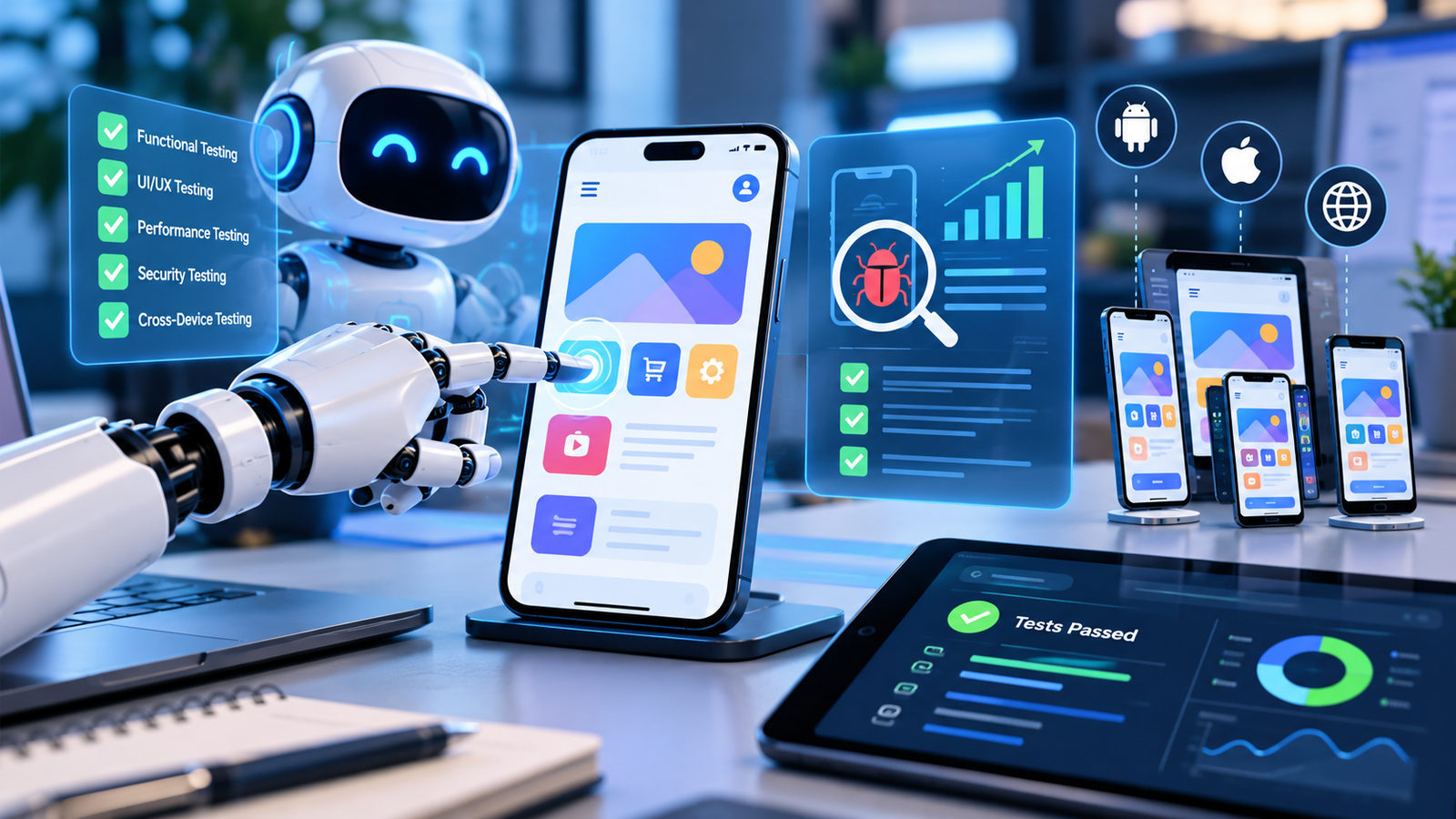
An app may pass every single test on a developer’s best-of-the-best phone and fail on an Android phone three years old with a poor internet connection. Testing a mobile application requires considering hundreds of screen resolutions, OS versions, manufacturer customizations, and connection types. Performing these tests manually for each release takes too long and can be prone to errors. AI-driven testing solutions attempt to alleviate the testing process by providing suggestions on how to test an app, detecting visual flaws, and fixing fragile test scripts. However, such solutions do not substitute a QA team’s expertise but rather help them.
What Are AI-Powered Mobile Testing Tools?
Rule-based automation executes the defined actions: click on the element with this ID, then assert this text. When the developer changes the name of the ID or the location of the button, the rule-based automation stops working, although the application itself still functions. AI testing of mobile applications introduces the component that is able to deal with such inconsistencies. Machine learning(ML) can be used in software testing to generate test cases based on the behavior of an application and previous results, evaluate screen comparisons as humans do, prioritize tests based on risks, and detect anomalies in logs/performance metrics. Our detailed guide to AI and machine learning for mobile application testing will give you more details about how all these technologies work.
Key Trends in AI-Powered Mobile Testing
Intelligent test-case generation. A tool that studies how testers move through a retail app, along with its defect history, might propose a scenario nobody scripted, such as applying a discount code after the phone switches from Wi-Fi to mobile data mid-checkout.
- Self-healing automation. Suppose a redesign changes a login button’s ID. A self-healing tool can match the element by its position, text, and neighbors and keep the test running. The risk is that a heal can also hide a genuine regression, so healed steps deserve a look.
- AI-powered visual testing. The technology can detect a chopped-off price tag on the tiny display screen and a hidden button under the keyboard, without being distracted by all those minor discrepancies in rendering that mislead pixel-perfect comparison. This is proved by studies into machine learning applied to UI testing.
- Predictive Testing. When the commit involves payment-related code, then the predictive model trained on previously failed builds will bump up payment tests to the head of the queue to have CI flag potential issues earlier. None of the above works perfectly, but all require testers to verify the information they provide.
Benefits of AI in Mobile App Testing
The most obvious benefit is reduction in repetition. The automated regression tests will be able to run unattended with each build, while AI-driven maintenance means spending less time fixing the scripts when the UI is slightly changed.
The quality of coverage improves too. The combination of device clouds and scenarios created allows reaching combinations that manual planning cannot identify, which is important in cross-platform mobile testing. Early detection of defects, along with risk-based prioritization, enables QA managers to allocate seasoned personnel to do exploratory testing, usability testing, and edge-case testing. Teams lacking automation capabilities internally can hire automation testers for mobile test automation.
However, these are not assured gains. It all depends on how complex the application is, the quality of test data, whether or not the tool fits into your testing stack, and its implementation. Having an artificial intelligence on top of your ill-kept testing suite will not fix that suite.
Popular AI-Powered Mobile Testing Tools
These tools do not offer the same kind of AI, so it helps to separate them by what they actually do.
Appium is an open-source automation framework. It is not AI-native, but it is widely used as the execution layer beneath AI-assisted tools. Testim from Tricentis offers a mobile extension that runs tests on physical devices or emulators, and Tricentis describes its self-healing Smart Locators as a way to keep tests stable. Applitools focuses on visual AI validation, useful for catching layout defects across devices. sdtimestricentis
BrowserStack is mainly real-device infrastructure, but it now offers a self-healing agent for Appium tests in App Automate, available on its Pro plan. Its documentation also notes that self-healing may let a test pass despite an underlying app issue. Maestro takes a different route, with readable YAML flows for Android, iOS, and web and a focus on simple, fast authoring. Its strength is approachable automation rather than headline AI features. self healing +2
In short, these mobile app testing tools span AI-native features, cloud device access, and plain automation. Match the tool to the bottleneck you actually have.
Challenges and Best Practices
AI tools can produce false negatives and positives in test recommendations. Test data and automation workflows still need maintenance. Integrating a new tool into your pipeline takes effort, and teams face a learning curve. Device and OS fragmentation does not disappear, and privacy deserves attention too, since screenshots and logs may contain user data. Fragmentation is easier to handle when testing is planned alongside the build, which is one reason many teams work with a mobile app development partner that treats QA as part of delivery.
For mobile app testing best practices, start by focusing on one single problem. This may be, for instance, that your regression suite is flaky. Do a small pilot, check the results from the AI manually, and measure the outcomes.
Conclusion
Mobile testing software driven by artificial intelligence can enhance mobile application quality assurance through better test executions, defect detection, and coverage. Such software works best in conjunction with talented testers, who ultimately determine what to look for and what is really a defect. For organizations considering this possibility, the mobile app testing services of CMARIX provide one potential solution.
The Author


No Comment