
How to Know If Your Business Is Ready for AI Implementation

Most businesses think they’re ready for AI. They’ve read the case studies. They’ve seen competitors launch AI projects. They’ve gotten the budget approved.
Then they implement, and everything falls apart.
The data is messier than expected. The existing systems don’t talk to each other. The team doesn’t know how to work with AI. The timeline stretches from months to years. The budget doubles. Leadership stops supporting the project. Six months in, the company abandons AI and declares it doesn’t work for their business.
This happens not because AI doesn’t work. It happens because the business wasn’t ready.
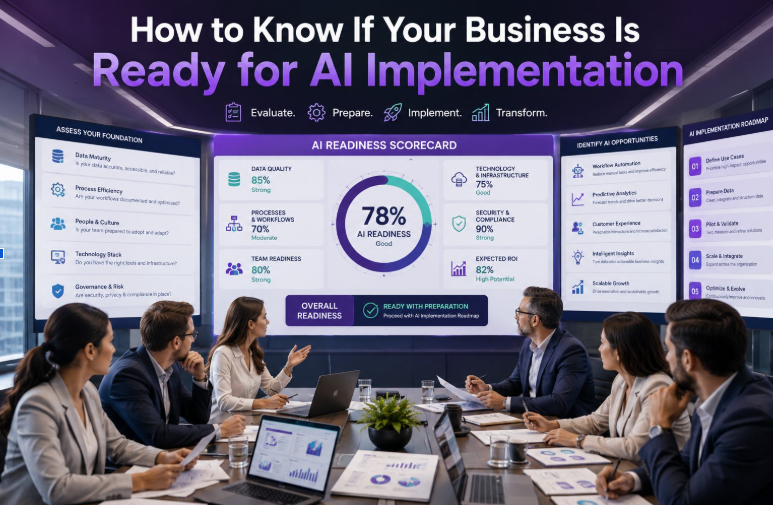
Being ready for AI isn’t about having perfect data or the latest technology. It’s about being honest about where you stand across five specific areas. This article discusses those areas and gives you a way to assess your actual readiness.
The Real Cost of Being Unprepared
Rushing into AI without readiness creates concrete financial damage.
Companies that skip the AI assessment phase waste between 30% and 50% of their AI budget on problems that would have been obvious if someone had looked. They build systems that can’t integrate with existing workflows. They hire expensive consultants to fix problems that preparation would have prevented. They lose team members who get frustrated by chaos. They burn through the budget on pilots that never become real products.
These aren’t theoretical costs. They’re real projects at real companies that failed because the foundation wasn’t solid before building on top of it.
Being unready doesn’t mean AI won’t work for your business. It means you’ll pay significantly more to get there, take longer to see results, and risk killing the entire initiative before it delivers value.
The Five Areas You Need to Assess
Success with AI depends on five specific capabilities working together. Weakness in any one of them creates problems downstream.
1. Data Quality and Accessibility
AI systems run on data. The old saying is true: garbage in, garbage out. But most businesses don’t know the actual quality of their data until they try to use it for AI.
Ask yourself Do you know where your data actually is? Is it in one system or scattered across five different databases? Can you access historical data, or does it go back only two years? Is your data clean, or do you have duplicate records, inconsistent formats, missing values, and conflicting information across systems?
Many companies discover their data governance is years behind reality. Files exist in multiple versions. Column names mean different things in different systems. Records are incomplete. Privacy compliance is unclear.
This doesn’t mean you can’t do AI. It means you need to fix the data before AI will work well.
2. Technical Infrastructure
Your current systems need to support AI. This includes cloud infrastructure, database performance, API connections, and integration capability.
Can your existing systems handle the computational workload AI requires? Do you run everything on-premise or have cloud infrastructure? Can new AI systems connect to your CRM, ERP, and other critical software, or would they be isolated islands of data?
Legacy systems complicate everything. If you’re running software from 2010, connecting it to modern AI tools becomes an engineering challenge. That’s not a blocker, but it’s a cost and timeline factor that needs to be in the budget.
3. Team Skills and Organizational Readiness
AI changes workflows. People need to understand how. Your team needs either existing expertise or the capacity to learn quickly.
Do you have people who understand data engineering, model training, and AI integration? If not, will you hire them or work with external partners? Either path takes time and money.
Beyond individual skills, your organization needs to be ready for change. Process workflows will shift. Some tasks will be automated. Other tasks will be redefined. Teams need to understand what’s happening and why. If your organization resists change or moves slowly, AI implementation will be painful.
Executive alignment matters enormously. If the CEO believes in AI but the operations team doesn’t, the project will struggle. If different departments have different priorities for AI, decisions become political instead of strategic.
4. Financial Capacity
AI costs more than most businesses budget for.
Implementation isn’t just the software. It includes data cleanup, infrastructure upgrades, external expertise, internal team time, and ongoing maintenance. A realistic budget for meaningful AI implementation is often $200K to $1M+, depending on scope.
But that’s just the beginning. AI requires continuous investment. Models drift and need retraining. Data quality maintenance is ongoing. Monitoring and optimization happen constantly. If you expect to implement AI once and move on, you’re underestimating what it requires.
Can your business sustain investment for 12-24 months before seeing meaningful ROI? If you need returns in three months, AI probably isn’t the right solution.
5. Strategic Clarity
Why are you implementing AI? This question matters more than any technical consideration.
“We want to use AI” isn’t a strategy. “We want to reduce manual ticket classification by 60%” is. The first is vague and will fail. The second is specific and measurable.
Define which business problems AI will solve. What metrics will tell you whether the implementation succeeded? Is this solving a critical bottleneck, or is it a nice-to-have improvement?
If you’re implementing AI because competitors are, that’s a weak strategy. If you’re implementing it because it solves a specific, expensive problem in your business, that’s strong.
Quick Readiness Assessment
Score your business on each area. Use 0 (not ready) to 5 (fully ready):
- Data quality and accessibility: Can you access clean, complete data? (0-5)
- Technical infrastructure: Do your systems support AI workloads? (0-5)
- Team skills and change readiness: Does your team have the capacity to learn and adapt? (0-5)
- Financial capacity: Can you fund implementation and ongoing costs? (0-5)
- Strategic clarity: Do you have a specific problem AI will solve? (0-5)
What your score means:
- 20-25: You’re ready. Move forward with implementation.
- 15-20: You’re partially ready. Address the weakest areas before full implementation.
- 10-15: You’re not ready. Spend 6-12 months on preparation.
- Below 10: Focus on foundational work before considering AI seriously.
What “Not Ready” Means
Scoring low doesn’t mean “don’t do AI.” It means “don’t do AI yet.”
Not ready means you need to fix the foundations first. Clean your data. Build infrastructure capacity. Train your team. Get leadership alignment. Define your strategy clearly.
This preparation phase typically takes 6-12 months. It’s not glamorous. It won’t show up in press releases. But it’s the difference between AI implementations that succeed and those that fail.
Red Flags That Mean “Wait”
Don’t implement AI if any of these are true:
- Leadership hasn’t agreed on why you’re doing AI
- You don’t know the quality of your data
- You lack in-house IT capacity to support integration
- You’re implementing because competitors are, not because it solves a real problem
- You expect full ROI within three months
Any one of these isn’t a permanent blocker. But each one means you’re not ready yet. Fix it first.
If You’re Not Ready, What’s Next?
- Start with data: Audit your data quality. Create a data cleanup plan. Establish governance so data stays clean going forward. This takes months but is essential.
- Build infrastructure: Assess your current systems. Plan cloud infrastructure if needed. Set up systems that can talk to each other. This is technical work that takes time but prevents problems later.
- Invest in team: Hire people or build partnerships. Run training on what AI can and can’t do. Create internal champions who understand the technology.
- Get alignment: Get leadership agreement on what problem you’re solving and what success looks like. Document this. Reference it when decisions get political.
- Define strategy: Pick one specific problem AI will solve first. Not five problems. One. Start small, prove it works, then expand.
The Bottom Line
Readiness isn’t about being perfect. It’s about being honest.
An honest assessment at the beginning saves enormous amounts of money, time, and frustration later. The businesses that succeed with AI are the ones that look at their actual situation, acknowledge the gaps, fix them, and then implement from a solid foundation.
The businesses that fail are the ones that assumed they were ready, or that hype about AI meant they didn’t need to do the hard preparation work.
You know which one you want to be.
The Author


No Comment