
Gen AI-Powered Legacy App Modernization: A Complete Overview

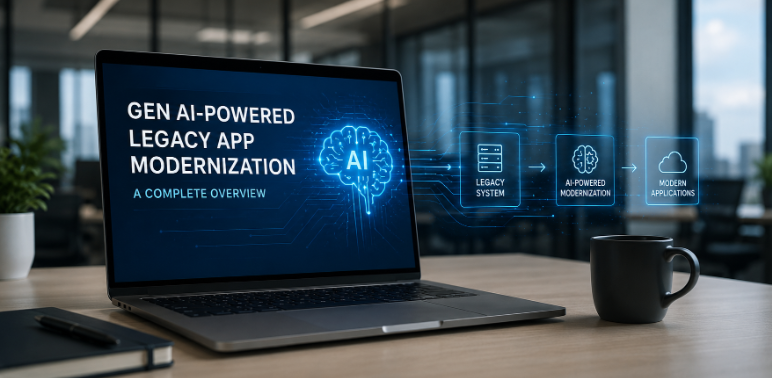
Legacy software solutions still provide critical functions of many organizations. As a result, many legacy systems are faced with high cost maintenance, various security concerns, and limited levels of scalability. Traditional methods of modernizing applications can take years and be quite resource intensive.
Generative AIs will allow businesses to develop legacy apps into their modern form with far less time and effort required for application modernization processes through automation tools that provide support for code review, migration, testing, and documentation.
What’s Legacy Application Modernisation?
Legacy app modernization is the process of updating outdated software systems to meet current business and technology requirements. Businesses often rely on legacy system modernization services to migrate applications to the cloud, refactor old code, improve security, and redesign user interfaces.
Many legacy systems are built on outdated technologies that are difficult to maintain and integrate with modern platforms. Gen AI simplifies this process by helping developers analyze, convert, and optimize code more quickly.
Applications of AI for Modernization Projects
Gen AI is applied to modernization projects through the automation of repetitive coding tasks, streamlining complicated database migrations and various legacy transformation processes. As businesses look to modernize their legacy systems, they will continue to use AI for these transformation projects.
Automated Code Analysis
The modernization process includes one of the most challenging pieces, which is the understanding of legacy systems (a.k.a., “old codebases”), which have very little to no documentation. Utilizing Gen AI can assist in analyzing source code, identify dependencies and automatically create technical documentation.
By using Gen AI, Development Teams are better able to understand how a system is architected and reduce the amount of discovery time on projects.
Code Refactoring and Migration
Generative AI can translate an organization’s legacy source code written in older programming languages and/or frameworks to the latest technologies. For example, organizations may convert their current COBOL or .NET systems into cloud-native applications.
While developers still have to verify the final product, generative AI will have a considerable impact in reducing the amount of manual code written by developers.
Test Automation
Many times, there are insufficient tests for legacy systems. Generative AI can create unit tests and regression tests to provide teams with early detection of defects and to enhance the quality of their products.
Assistance With Cloud Migration
The cloud migration process can be helped by using AI tools to identify workloads suitable for containerization and provide recommendations on how to optimize cloud platforms like AWS and Azure.
Advantages of Using Gen AI
Gen AI assists enterprises in rapidly modernizing legacy systems by decreasing the manual workload associated with legacy systems while allowing for faster program development and less operational risk associated with a legacy system. The benefits provided by Gen AI to support legacy modernization will ultimately allow the legacy modernization process to move faster, be more scalable, and be more cost-effective.
Rapidly Modernizing
The use of AI allows for repetitive processes such as documenting, converting code, and performing tests to be automated. This allows for a greater velocity in getting new applications deployed.
Decreased Cost
Legacy modernization is costly, especially when organizations have to rely on antiquated technology (infrastructure) and specialized resources. Gen AI allows organizations to decrease their costs through increased productivity from developers, as well as minimizing their manual workloads.
Lowering Your Risk
By utilizing automated testing and the analysis performed by an AI system, an organization may identify potential problems before going into production, thereby decreasing their risk of experiencing a significant business interruption.
Enhanced Scalability
By utilizing cloud-native technology and microservices, organizations can better scale and improve the performance of their modernized applications.
GenAI Impact on the Price of Legacy Modernization
Price for Modernization projects will depend on the complexity of the Application, the Scope of the Project framework and the Technology Stack being utilized.
Small Modernization Project will have potential prices between $50,000 to $150,000 at this range, whereas enterprise-level transformations can be priced over $1 million. However, Artificial Intelligence can decrease the overall price by:
– Automating Code Generation & Refactoring
– Reducing Test Time
– Speeding Up Migration Timelines
– Decreasing reliance on Legacy Specialists
Additionally, Organizations should factor in cloud Infrastructure, licensing and Human oversight expenses associated with AI.
Conclusion
For companies to be successful and stay relevant in today’s digital marketplace, it is important to update their older application systems through a modernisation programme. Using Gen AI when updating legacy app systems will help an organisation to speed up the process of development by automating repetitive processes that slow down traditional development methods. Thus, while AI will not replace developers, it will enable them to be more productive, as well as assist them with modernising their older applications more quickly.
The Author




No Comment