
Predictive Analytics in Fantasy Sports: Key Use Cases and Benefits

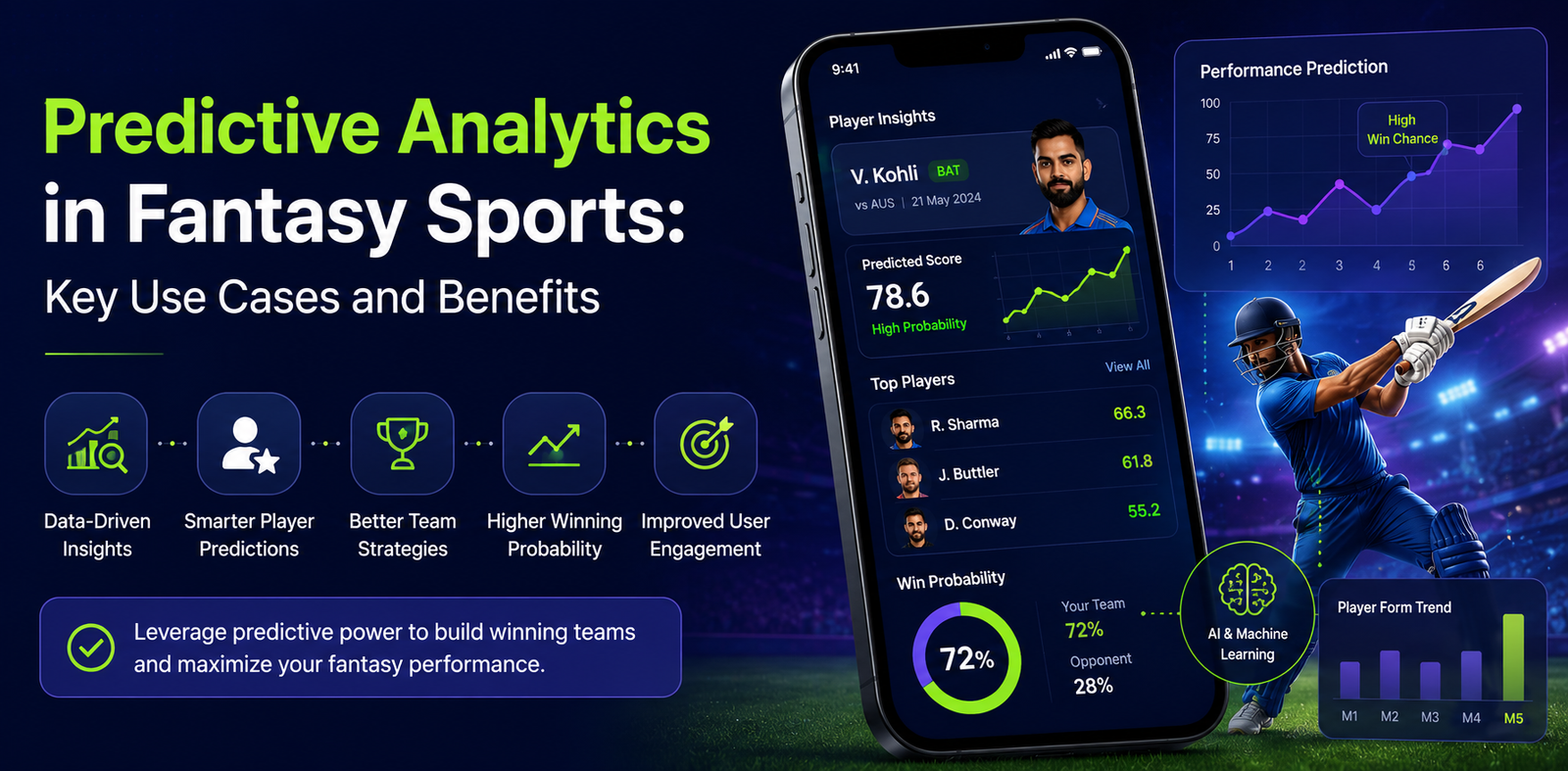
Fantasy sports have transcended the basic process of selecting players and monitoring their scores. Advanced data intelligence has made modern fantasy sports platforms capable of providing valuable information and personalized experiences to users. Predictive analytics in fantasy sports, for example, has turned out to be one of the most valuable technologies that can bring benefits to both business and users.
The use of historical performance of players, real-time statistics, current conditions of the player and his team, weather changes, and user interaction data enables platforms for fantasy sports to provide valuable insights to users even before the game starts. Such an approach allows increasing the accuracy of player prediction and improves engagement and platform performance.
In a competitive environment, predictive analytics has become a must-have technology for any successful business that aims at increasing user satisfaction and earning more money.
What Is Predictive Analytics in Fantasy Sports?
“Predictive analytics in fantasy sports” means the practice of predicting future events pertaining to sporting events or fantasy gameplay using historical data, algorithms, statistics, and artificial intelligence.
While traditional analytics only use historical data, predictive analytics takes into consideration hundreds of other factors at one time such as player form, injuries, strength of the opponents, performance in a particular location, weather conditions, previous match statistics, and user preferences in order to predict future events accurately for users to build a good team.
Unlike traditional analytics that explain what has already happened, predictive analytics focuses on identifying what is most likely to happen next. This proactive approach enables fantasy sports platforms to provide recommendations that improve user confidence and decision-making.
Why Predictive Analytics Matters in Fantasy Sports
A Fantasy Sports player demands more than just basic scoring information from their platform. They require intelligent recommendations, insights, and guidance that allow them to outperform other competitors. This is where predictive analytics comes into play. It turns large amounts of sports data into useful insights.
Predictive analytics provides numerous benefits for the platform owner. It promotes increased engagement by offering personal experiences, improved retention by providing valuable recommendations, and operational efficiency by automating decisions.
In light of the growing popularity of fantasy sports with millions of users across the globe, the use of predictive analytics provides a huge competitive edge over conventional approaches to data analysis.
How Predictive Analytics Works in Fantasy Sports Platforms
Predictive analytics starts with gathering data from various reliable sources such as previous match history, player data, live match data, injury status, team statistics, and user activities.
Further, this data is analyzed using machine learning and statistical modeling to find the underlying patterns, measure consistency of players, predict future performance, and refine the predictions with new data.
The predictions that have been made are then added into the fantasy application in terms of player recommendations, projected scoring, risk assessments, notifications, contest recommendations, and strategies that help users create good fantasy teams.
There has been an increased focus on predictive analytics among the companies that develop applications for fantasy sports games due to its ability to increase user engagement as well as make the platform more intelligent.
Top 5 Use Cases of Predictive Analytics in Fantasy Sports
1. Smart Player Performance Prediction
Predictive analytics evaluates historical records, recent performances, injuries, weather conditions, and opponent strength to forecast player outcomes. These insights help fantasy users confidently select high-performing athletes while reducing uncertainty before creating their fantasy teams.
2. Personalized Team Recommendations
Advanced predictive models analyze user preferences, previous team selections, contest history, and player combinations to generate personalized team recommendations. This customized approach improves user satisfaction while increasing participation across multiple fantasy contests.
3. Real-Time Match Insights
Predictive systems continuously process live match statistics, player momentum, substitutions, and game events to update performance projections instantly. Users receive dynamic recommendations that help them react quickly to changing match situations and improve decision-making.
4. Fraud Detection and Risk Monitoring
Predictive analytics identifies unusual user behavior, suspicious transactions, abnormal gameplay patterns, and potential fraudulent activities before they impact platform integrity. This proactive monitoring strengthens security while maintaining fair competition for all fantasy participants.
5. User Retention and Engagement Analysis
Behavioral analytics predicts which users may become inactive by evaluating login frequency, contest participation, and engagement trends. Platforms can launch personalized campaigns, rewards, and notifications that encourage users to remain active and loyal.
Top 5 Benefits of Predictive Analytics in Fantasy Sports
1. Improves Decision-Making Accuracy
Predictive analytics provides recommendations based on factual information rather than assumptions, making it possible for users to be able to make decisions that will help improve the quality of their fantasy teams based on performance trends, statistics, and probability.
2. Enhances User Experience
Individualized recommendations, alerts, customized dashboards, and real-time predictions provide an enhanced user experience. Users tend to use the application more often because all recommendations are pertinent to the user.
3. Increases User Retention
The accurate prediction and personalization of user experience will motivate them to come back for future tournaments. High engagement will create loyalty among the customers, increase the number of daily active users, and will enhance the growth of the platform.
4. Boosts Platform Revenue
Increased user engagement will result in contest participation, premium subscriptions, advertisements, and lifetime value of customers. The predictive analytics has a direct impact on the revenue growth of the platform.
5. Creates a Competitive Advantage
Intelligent predictions, recommendations, and real-time insights help differentiate platforms from their competitors. Companies using predictive analytics have better market positioning, besides drawing in users who want more intelligent fantasy gaming.
Best Practices for Implementing Predictive Analytics
Successfully implementing predictive analytics requires more than collecting large datasets. Businesses should focus on data quality, model accuracy, continuous learning, and user-centric design.
Sports prediction algorithms need to incorporate reliable sources for data in order to predict accurately. The machine learning models should always be updated with new data in order to perform well through various sports seasons.
Companies also need to be transparent by informing users about the certainty level of predictions rather than recommending results as a guarantee.
Good data protection, security architecture, and scalable architecture are also important in order to perform consistently during high-traffic sporting events.
Companies investing in fantasy sports software development should prioritize scalable predictive models capable of handling millions of real-time calculations without affecting application performance.
Choosing the Right Development Partner
Integrating predictive analytics requires expertise in artificial intelligence, machine learning, cloud infrastructure, sports data integration, and scalable application architecture. Selecting an experienced fantasy sports app development company ensures businesses receive reliable solutions that align with their long-term objectives.
An experienced technology partner understands how to build intelligent recommendation engines, optimize predictive algorithms, integrate live sports APIs, and maintain high platform performance even during peak sporting events.
Businesses should evaluate development partners based on their technical expertise, industry experience, portfolio, post-launch support, and ability to deliver customized fantasy sports app development services that meet evolving market demands.
Conclusion
Predictive analytics is revolutionizing the fantasy sports sector through better recommendation systems, personalization, and decision-making. Whether in predicting the performance of players or in boosting user retention and enhancing platform security, the application of predictive analytics keeps growing due to advances in AI and machine learning.
Businesses that embrace predictive analytics in fantasy sports gain a competitive advantage by improving user engagement, enhancing operational efficiency, and creating more valuable digital experiences. As user expectations continue to grow, predictive analytics will remain a fundamental technology for building intelligent, scalable, and successful fantasy sports platforms.
The Author


No Comment