
Why Back-End Development Matters for Scalable Web Apps


Users may be drawn towards a sleek design of a web application but it is the functionality of the backend that matters when fulfilling the requirements of the public. Development on the backend implies the establishment of server-side logic, databases, APIs, integrations, authentication, as well as infrastructure for the web application.
The listed aspects provide for making requests, keeping information, controlling business processes, as well as linking the application with third-party services.
A lack of solid foundation on the backend means that even if the application is very attractive regarding design, it may be slow, unreliable, and insecure.
Scalability starts with architecture
Performance may not be as good for thousands of people as it was for hundreds of users. Problems such as slow responsiveness, database overload, unsuccessful API calls, and service interruptions may be caused by poor architectural decisions.
Scalable backend development solutions make it possible for applications to handle more users, transactions, and data without rebuilding the entire system. This usually involves load balancing, caching, database query optimization, cloud infrastructure, and non-blocking processing.
Good architecture also makes adding new features easier and less time-consuming.
Performance depends on efficient processing
Good efficiency improves performance. A single action by the user can trigger multiple processes on the server. Loading a product page on an e-commerce site may mean that product information must be obtained, stock levels checked, discounts calculated, customer reviews gathered, and tailored recommendations provided.
Given that processing these tasks in a bad manner will slow down the application.
Good back-end development is necessary for reducing processing and stabilizing response time. To optimize processes, the development uses such techniques as database indexing, caching, query optimization, and background task processing.
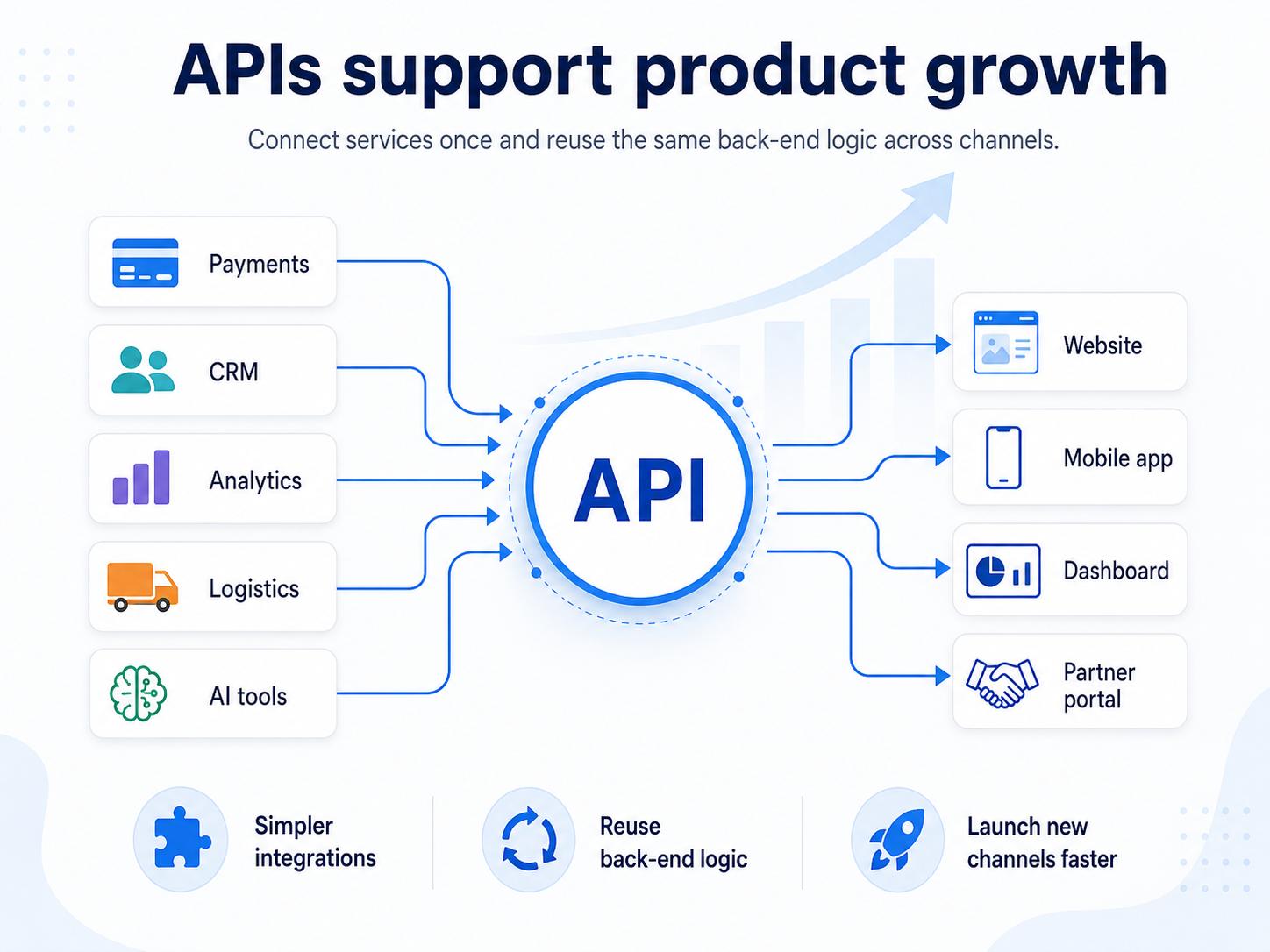
APIs support product growth
Modern web apps very seldom work independently. They most often connect to payment, CRM, analytics, and logistics systems, as well as AI and other third-party solutions
With a well-structured API, integration becomes simpler, and the same back-end server logic can be applied to different platforms (websites and mobile apps, in-house dashboards, and partner portals).
This flexibility means less redundant development and allows for a quick introduction of new digital channels.
Database design affects long-term performance
As an application grows, its database must handle more records, queries, and simultaneous users. Poor database structure can quickly become a serious performance bottleneck.
Scalable systems rely on efficient data models, proper indexing, replication, backups, and optimized read and write operations. In some cases, businesses may also use several database technologies for different types of workloads.
Choosing between relational and NoSQL databases should depend on the application’s data structure, consistency requirements, traffic patterns, and future growth plans.
Security belongs in the back end
Security should be integrated within back-end systems
The back end safeguards the users’ accounts, private information, monetary transactions, organizational data, and processes.
When establishing security systems, measures such as secured authentication systems, role-based access, encryption, input validation, rate limiting, and secured session management must be included from the start.
Trying to put security into place after the application has been created and launched is more difficult and costly.
Cloud services make scaling easier
Cloud platforms, such as Amazon Web Services, Microsoft Azure, and Google Cloud, include the tools for automatic scaling, database management, monitoring and backup, and disaster recovery.
These types of services allow the applications to be flexible towards changing traffic patterns without any involvement of the businesses in maintaining components of the infrastructure.
The cloud environments make it easier to deploy applications across multiple regions, increase availability and diminish the effects of system failures.
Asynchronous processing improves responsiveness
A response can be provided to a user without waiting for certain processes to complete.
For instance, operations involving the sending of emails, the creation of reports, the processing of pictures, the synchronization of data, and the functioning of AI systems can be carried out without blocking the operations.
Asynchronous processing lets your program stay responsive and does not allow any lengthy processes to jeopardize user experience, which is particularly useful for services working with large amounts of data or complicated workflows.
Monitoring supports continuous improvement
For successfully scalable web applications, continuous performance monitoring is required.
With the help of monitoring tools, teams can understand API response speed, the amount of database usage, error rates, infrastructure load as well as user behavior.
Also, the monitoring tool assists in knowing how to predict bottleneck issues that usually cause a great number of issues for users.
Additionally, ongoing monitoring ensures that the decisions regarding the costs of the infrastructure used and future need for infrastructure improvement and scaling are being made based on good reasoning and the needs of the application.
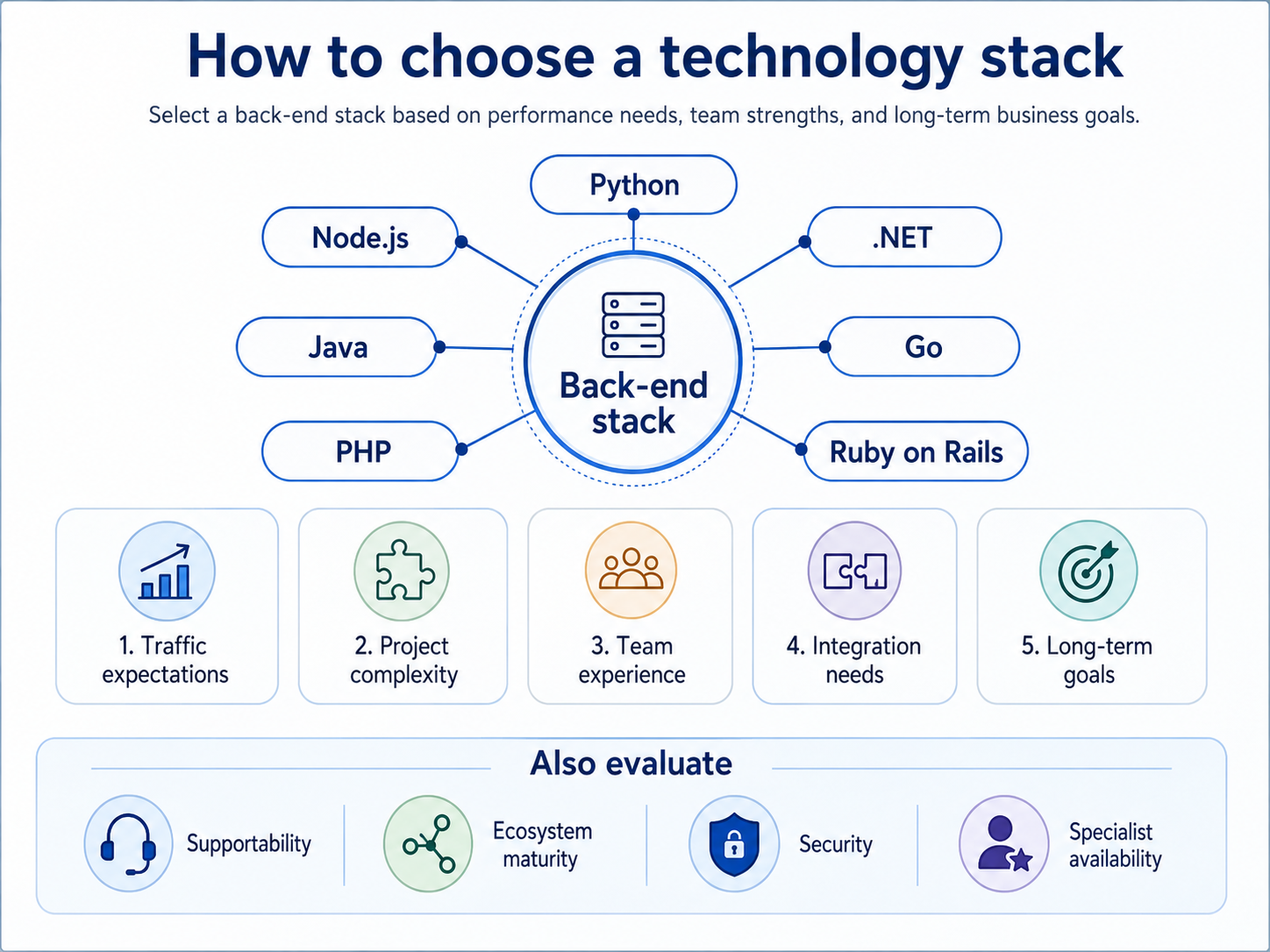
How to choose a technology stack
Some widely used back-end technologies are Node.js, Python, Java, .NET, Go, PHP, and Ruby on Rails. It is essential to pick a technology stack according to the anticipated traffic, project complexity, team experience with working with different technologies, system integration needs, and long-term goals of the business.
Each technology stack should also be looked at from the viewpoint of supportability, maturity of the respective ecosystem, and safety, as well as the availability of specialists familiar with the respective technology.
Principles of credible back-end web development
Businesses can use some practices to create a reliable and efficient back-end:
- Design APIs with possible integrations in mind
- Optimize queries in database performance
- Use caching for frequently requested information
- Move lengthy processes to the background
- Automate the process of testing and deployment
- Monitor the application’s performance constantly
- Secure application development from the very start
By doing these things in the beginning, businesses can cut down on the expenses of the future development process.
Conclusion
The importance of back-end development cannot be underscored enough: it provides the basis for web application scalability. The back end is responsible for such parameters as security, performance, integrations, and data processing.
Having an efficient back end helps enterprises to grow and develop, thus allowing them to add customers and new functionalities as well. In other words, the initial investment in the back-end solutions will definitely pay off in the future and lead to a reduction of technological expenses as well as provide a solid basis for further product development.
The Author




No Comment