
AI Agents in Business: Practical Use Cases Beyond Customer Support


Artificial Intelligence agents are spreading their wings beyond the most known duty of providing customer care. Companies start utilizing them for administrative tasks, financial operations, sales, software engineering, and other procedures that need more than mere replying.
Their biggest advantage lies in the fact that AI agents act to accomplish a goal. Depending on their configuration, they can look for information, communicate with automated systems, evaluate various options, and accomplish a series of actions. This opens doors to automating procedures that needed human intervention in the past, requiring their manual activity across the various tools.
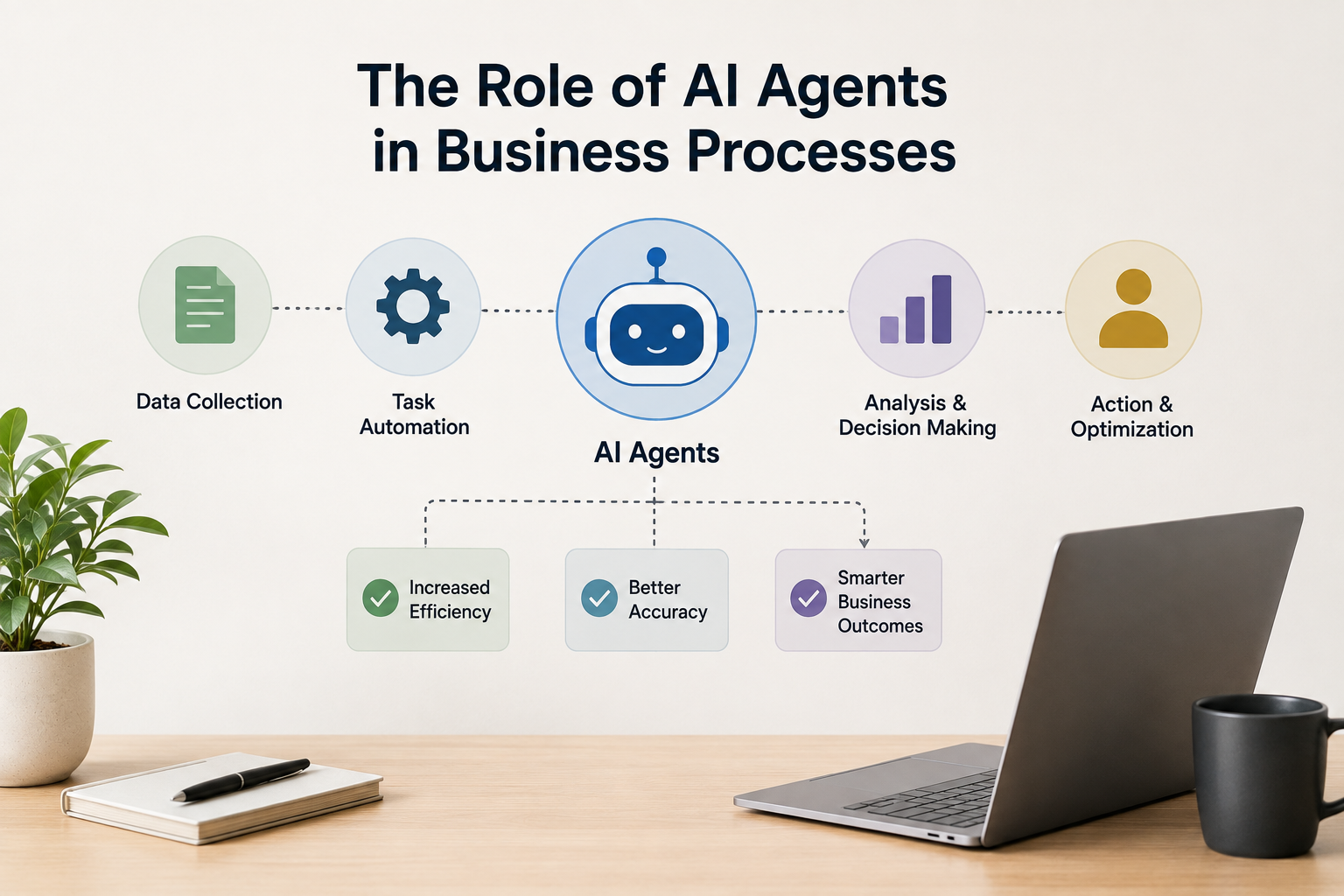
The Role of AI Agents in Business Processes
Use of traditional automation is appropriate in cases of repetitive processes, such that if the condition is in place, the corresponding action follows in accordance with the set plan. Unlike this, AI agents are capable of executing processes where the decision of what should come next relies on the specific instance of the process. This can be especially useful for an AI-assisted development team working with more complex and context-dependent workflows.
The agent receives the problem, collects information from various information systems, analyzes it, and takes the necessary measures. As an illustration of this difference, the traditional agent can make a summary of an invoice to arrange payment, while the AI agent would check it with the order, find discrepancies, update the accounting system, and report some unusual cases for human scrutiny.
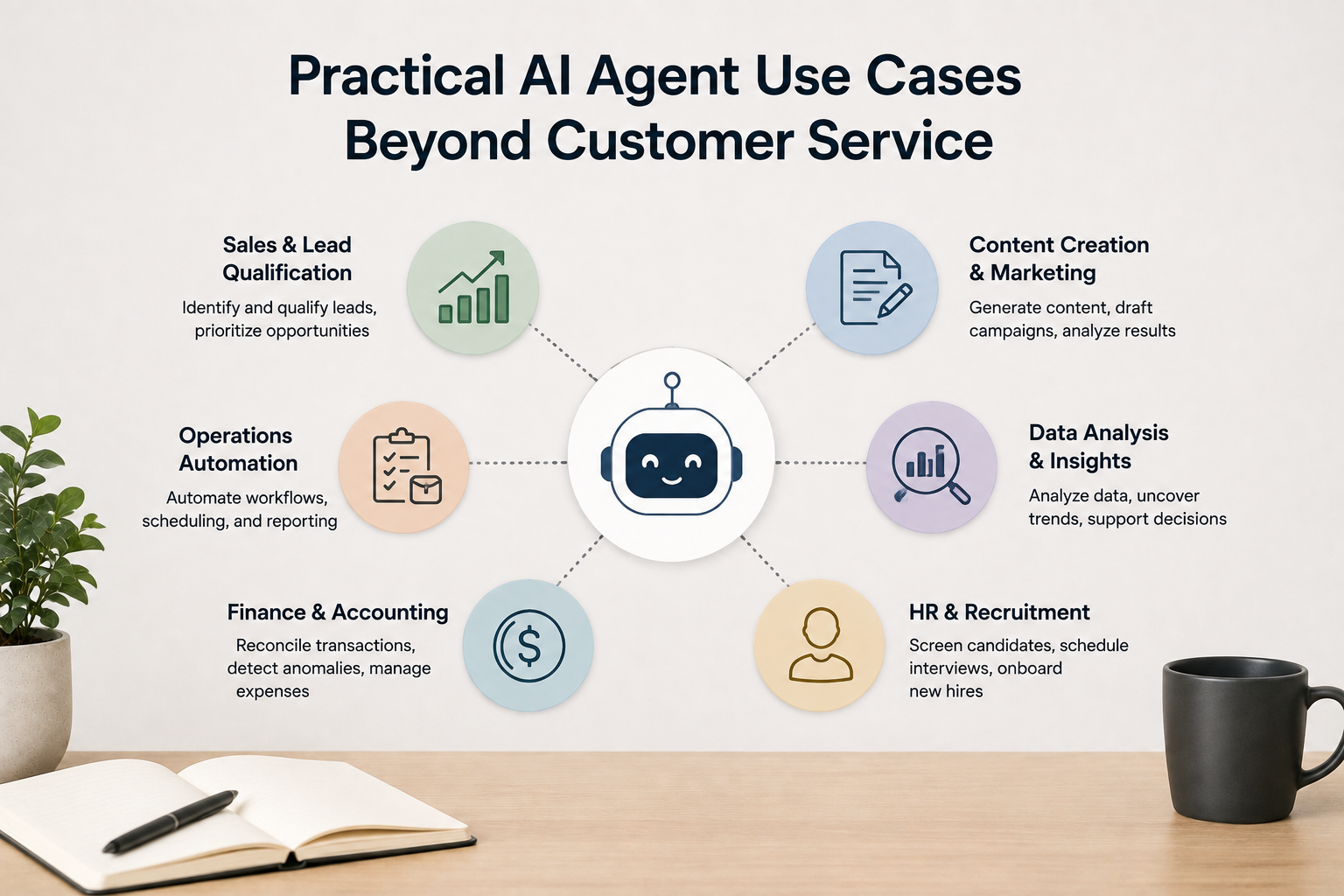
Practical AI Agent Use Cases Beyond Customer Service
Artificial intelligence agents may employ their abilities in the functional processes of any organization where there exist a number of activities involving harvesting data and utilizing different systems to make logical solutions and execute various actions.
Management of Sales and Leads
Sales groups allocate lengthy durations in vetting prospects, keeping CRM records, setting up appointments, and interpreting which leads need to be engaged.
AI advocates are capable of collecting data from acceptable sources, combining it into existing CRM data and compiling prospects files efficiently.
AI tools don’t replace but rather assist sales representatives and do most of the groundwork.
Finance & Accounting
Financial processes include multiple tasks that are repetitive but still need some interpretation.
Agents can assist in processing bills and invoices, classifying costs, reconciling operations, tracking budgets, and generating reports. An agent can cross-check the invoice with other data, mark unusual amounts, and send the document over to the correct employee instead of requiring someone checking each transaction manually.
Since finance operations carry a risk, it is important that permission, audit trails, and human approvals are incorporated into these processes.
Internal Knowledge and Research
Workers frequently waste valuable time sifting through documents, emails, knowledge bases, and business applications to discover piece of information that is pretty simple but hard to find.
When AI assistants take over such tasks, they connect to all internal resources and complete research across different systems.
They are able to find respective documents, check the information, and finally present conclusions along with references to the information source.
This technology can be effectively used in market research and competitive analysis.
AI agents are able to gather data from external sources, aggregate the information, and generate structured reports useful for employees.
Software Development and IT Operations
AI agents not only assist engineers with coding but also for other tasks.
They ensure bug reports are analyzed, logs checked, code documents inspected, tests generated and anything else that will improve the process. In IT operations, the role of the agents is to collect all relevant system information while the engineer is still not involved in the task.
For instance, if the application fails, the agent is capable of reviewing logs to correlate the issue with the latest deployment, link it to the exact component affected and prepare a summary.
Procurement and Supply Chain Operations
The procurement department frequently assess the vendors’ proposal as well as reviews documents, examining the contracts.
Artificial intelligence-fueled agents are capable of collecting vendor information, organizing the proposals to compare them, checking for documents needed for negotiation, and also monitoring the dates mentioned in the contract. In addition, in supply-chain networks, they monitor production inventory, order information, and abnormal situations occurring within the process.
The agent may notice that inventory drops below the expected levels, view the current orders, and vendors’ information, and propose what to do next. Following the authority entitled to the agent, it may also prepare the request for the purchase.
What Makes a Process Suitable for an AI Agent?
AI agents are not applicable to each business operation. Traditional software and rule-driven automation are more efficient for many processes with a predictable nature.
Agent-driven automation is relevant in particular cases when workflows involve different systems, information needs to be retrieved multiple times, decisions must be made in context for each task, and several steps cannot easily be depicted as simple rules.
Businesses should first analyze processes, rather than seeking the areas of implementation of AI. Workflows characterized by a high rate of repetitive manual work and outcomes that can be measured easily deserve serious consideration.
Constructing AI Agents With Necessary Controls
Higher autonomy results in higher accountability. Organizations must clearly stipulate what systems an agent is allowed to access, what types of data it can work with, and what decisions it can make. All aspects related to authentication, authorization, data protection, monitoring, and audit trails should be contemplated at an early stage.
Human approval is especially important in sensitive situations where financial transactions, confidential data, production processes and important business decisions are involved.
In practice, it is much more prudent to begin with an agent helping the personnel people and gradually enhance its autonomy after its performance evaluation.
Advancing Business Automation
AI agents signal a movement from systems that just provide knowledge to systems that can be involved in business processes as well.
The use of AI agents is not limited only to customer service. Applications of AI agents can be found in sales research, finance, internal knowledge management, software development, IT operations, and procurement. The business functions mentioned above have processes where AI agents can decrease amounts of routine operations and help in accessing information better.
Most successful implementations would not be the most autonomous ones. Instead, they would be the ones capable of solving a distinct operational problem, while still having appropriate human oversight where this is important.
The Author


No Comment