
API-First Legacy Modernization: How to Upgrade Software Without Rebuilding Everything


As companies navigate their way through legacy software challenges, they find themselves making uncomfortable choices: to continue to depend on systems that are becoming costlier and harder to incorporate or to completely replace them and, consequently, suffer the repercussions of transition. Nevertheless, this is not the only alternative.
API-driven modernization approach enables gradual transition. Rather than switching software all at once, companies can take advantage of an API to expose their legacy software most valuable functions to the modern computing environment and gradually phase out excess components where modernizing them will be the most beneficial.
The final outcome is not just new software. It represents an architecture that helps the companies keep moving forward without completely losing years of experience and business logic included in legacy systems.
Why Complete Redesign Is Often the Wrong Approach
A legacy application may employ older programming languages, database systems, or tech architectures, yet still be able to conduct critical business operations without fail.
When you replace the whole system, you need to rebuild crucial processes, migrate data, establish system integrations, train users, and verify that everything works right on thousands of occasions.
The situation is most dangerous when there is no complete documentation on the software or when the ones who wrote it are no longer available.
There is a problem with continuous operations as well, as one cannot simply stop processing customers’ orders, payment claims, and shipments while one is working on a replacement system.
That is why modernization is more and more about gradual changes in architecture rather than a big migration.
Understanding the Concept of API-First Modernization
In an API-First approach, businesses can operate their business processes separately from the underlying obsolete technologies.
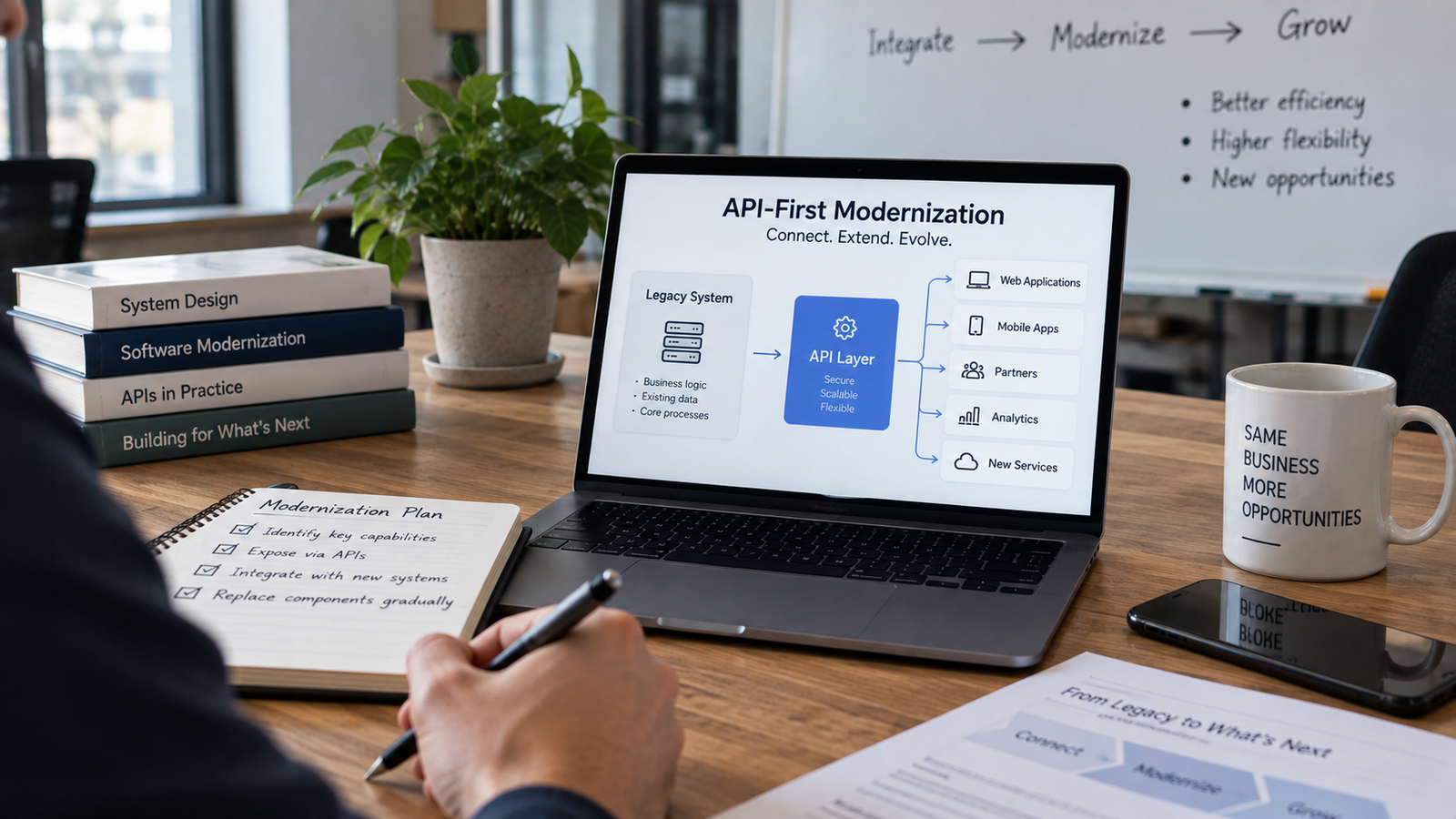
Take, for instance, an existing ERP system that has data on customers, warehouse inventory, pricing, and orders. In conventional approaches, another system will have to access the data in the database directly or rely on custom integration between the systems.
The API creates a layer of controlled interactions.
A web application can request the inventory information using an API. A mobile app can fetch customer details using the API. A partner can place an order via the API without being aware of how the ancient ERP is storing and processing the order.
Thus, the current application still continues to function, and APIs offer a modern way for other systems to communicate with it.
Progressively, the existing old-fashioned components can be replaced behind these APIs as well, often with support from a legacy software modernization company.
Where API-First Approach Offers Benefits
Integration is one of its most important benefits.
After all, legacy systems were developed at times when businesses had less digital tools at their disposal. Now, the same business must combine its established software with a number of things like CRM systems, cloud applications, mobile applications, analytics tools, payment systems, customer portals, and third party vendors.
Instead of organizing yet another custom connection with every new solution, APIs create a standard access point for all integrations.
Moreover, they offer greater convenience for frontend updates. A company can keep the business logic of the application while swapping out the ancient user interface for the modern web or mobile interface.
Lastly, the importance of automation cannot be overstated. Modern companies can provide their capabilities via a selection of APIs and, thus, provide access to their business processes through workflow engines, AI systems, and other automation tools without modifying existing systems in any way.
Modernize Around the Legacy System, Then Through It
API-led modernization works exceptionally well when it’s complemented with an approach of gradual decomposition. The first step is typically in grasping what the existing application is, including its dependencies, integrations, data flows, essential business rules, security restrictions, and technical debt of the application. Next, the team will figure out which capabilities could be exposed by APIs. For instance, the components of an order management system may expose functions like stock checking, client information downloading, order placement, checking order status, etc.
As new applications start using these interfaces instead of accessing the legacy system directly, world of modernization opens up.
The process of modernization may include replacing inventory management first of all since the component curbs scalability. A new service for inventory management is designed and plugged into the existing API contract which enables other applications to keep requesting inventory information effectively even if the technology behind API changes.
The same approach may gradually be applied to other components.
APIs Do Not Automatically Solve Legacy Problems
It is important to note that APIs do not automatically solve legacy issues. While it is true that adding an API on top of badly designed software is definitely a move toward modernization, it is also true that if the malfunctioning software is running a system plagued with issues regarding performance, reliability, security, or data quality, an API can make those issues easier to uncover and to act on. In this sense, the architecture needs to have well-defined boundaries.
Authentication and authorization need to be in place to regulate who can access which features. Rate limits will prevent too many requests from flooding the old infrastructure. Monitoring will allow tracking API performance in terms of availability, latency, errors, and strange behaviors.
Versioning must be taken into account to avoid errors as well. Once a number of applications rely on an API, a change of its operation without a proper lifecycle management may result in a new kind of debt.
It is equally important to understand that it is dangerous to expose a legacy database through an API directly. Ideally, an API should express the business processes and not just abstract database tables.
What Should Be Modernized First
Modernization tasks should not necessarily start with the oldest piece of code. What tasks should be prioritized is based on the impact to business.
A component is likely to be a candidate for modernization if it blocks business-critical processes, drives up the costs of integrations, creates security issues, does not scale with increasing volumes of requests, or requires too much manual work.
In order to decide if an area is worth addressing, teams should evaluate it from the perspective of business value, technical risk, integration requirements, maintenance costs, and complexity of dependencies.
This enables the creation of a modernization roadmap which is determined by constraints rather than a desire to modernize an old application.
The first API project should also be small enough for architecture validation. A defined business capability will be more preferable than exposing the whole legacy architecture at once.
Building a Bridge Instead of Starting Over
Legacy modernization doesn’t require a brand new system and years of programming in the making.
Using an API-first approach, organizations are capable of retaining their valuable logic while transforming their methods of using applications. This way, they can introduce new interfaces and simplify integrations while also being able to connect to the cloud and substitute obsolete parts of their software step by step.
Moreover, modernization can happen alongside traditional business activities.
This incremental method helps organizations with complex software projects to limit the risks associated with migration and allows obtaining the desired results. The goal isn’t to keep your outdated technology for eternity. It is to create your path from it without large-scale rebuilding efforts.
The Author



No Comment