
AI Pair Programming: Does It Actually Make Developers Better


Pair programming with AI is gradually turning into a usual element of how software gets developed. With the help of GitHub Copilot, Cursor, Claude Code, and similar tools, a developer receives code suggestions, gets explanations of functions he or she does not know, finds bugs, and solves technical problems without having to leave the development environment.
From the point of view of engineering teams, the reasons for interest are obvious: implementation goes faster, there is less monotonous coding, and more time is left for complicated tasks. However, a higher speed of writing code does not turn by itself into deeper technical skills or a higher quality of software.
What Is AI Pair Programming?
The traditional form of pair programming means that two developers work on one and the same task. While one of them is writing code, the other one looks through the decisions made, notices possible problems, and proposes how things could be improved.
The principle behind AI pair programming is close to this one, except that the role of the second participant belongs to a coding assistant powered by AI.
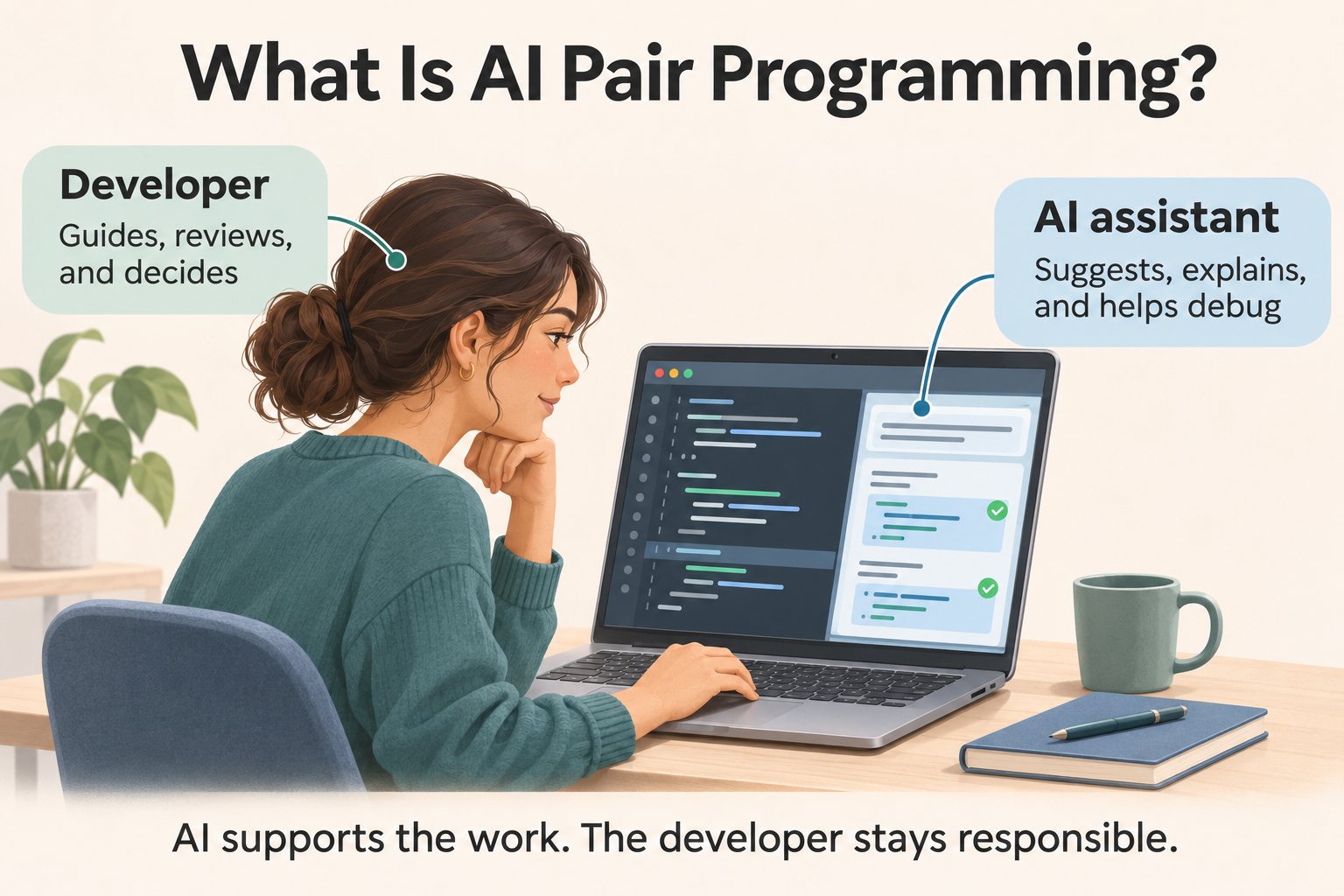
Among the capabilities met most often are the following:
- Code generation. Functions, components, and code structures of a repetitive kind are produced on request.
- Debugging assistance. The assistant finds probable errors and puts forward corrections for them.
- Code explanation. Logic, libraries, and frameworks unknown to the developer are broken down into understandable parts.
- Automated testing. Unit tests get generated, and test scenarios that are missing are pointed out.
- Refactoring support. For implementations that already exist, structural improvements are recommended.
Does AI Pair Programming Improve Productivity?
During an experiment held by GitHub, developers with Copilot coped with a programming task in JavaScript about 55% faster than the participants who had no access to it.
The outcome of a 2025 METR study was different, though. When AI tools were available, experienced open-source developers who worked on codebases familiar to them needed 19% more time for the completion of their tasks.
From these findings it follows that AI shows itself especially well on tasks with a clear definition, whereas in complex projects it may bring additional overhead.
This distinction has weight for companies delivering backend development services, since their productivity is a matter of reliable API integrations, database performance, system security, and maintainability over the long term, with the speed of implementation being only one part of it.
Developers still have to review the generated code, verify the assumptions behind it, and resolve integration issues.
Can AI Actually Make Developers Better?
The ability to write code at a high speed and the professional growth of an engineer are two things which do not coincide automatically.
In case AI pair programming is applied as an interactive means of learning, it supports professional development. Thus, a developer has the opportunity to request an explanation of a programming pattern unfamiliar to him or her, to compare alternative implementations, or to clarify on what grounds a particular architectural decision is considered appropriate.
At the same time, an excessive reliance on the solutions generated by AI is capable of weakening the skill of independent problem-solving.
Within a 2026 Anthropic study, the participants who resorted to AI assistance obtained 17% lower results in the subsequent assessment of skills in comparison with the participants who completed the programming exercise without AI.
Also, according to the research, the developers who actively posed questions and requested explanations showed a more solid understanding than the ones who primarily delegated the coding tasks.
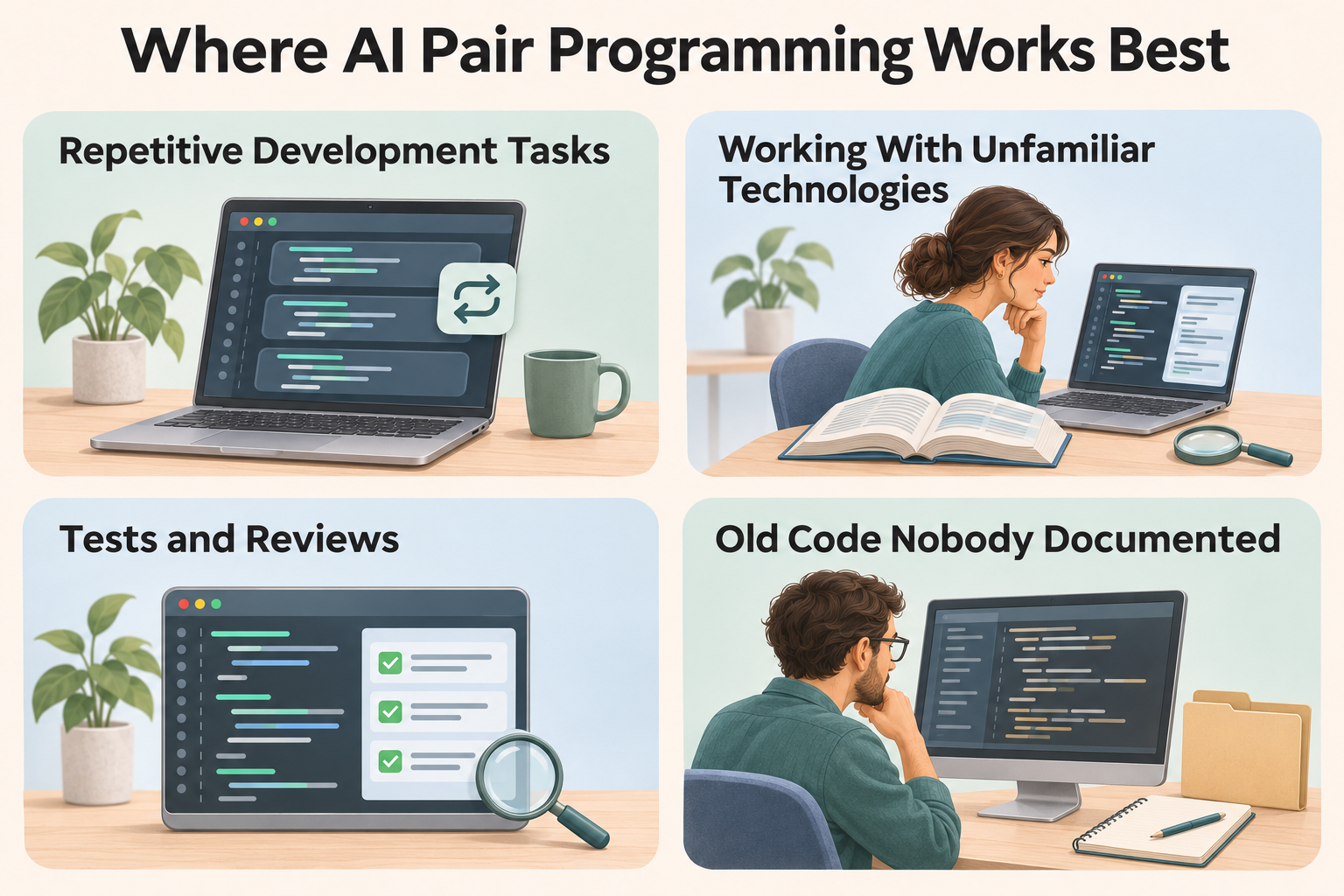
Where AI Pair Programming Works Best
Repetitive Development Tasks
The generation of boilerplate code, data models, configuration files, and standard API endpoints may be entrusted to AI.
Working With Unfamiliar Technologies
For a developer in the process of mastering a new framework or programming language, AI is of help in comprehending the syntax, the patterns of implementation, and the errors that occur most frequently.
The explanations obtained in this manner, though, are to be verified against the official documentation.
Tests and Reviews
AI assistants are able to put forward edge cases, compose test scenarios, and indicate fragments of logic which may turn out problematic.
Old Code Nobody Documented
In relation to legacy code, AI assists in the explanation of functions lacking documentation, in the tracing of dependencies, and in the proposal of refactoring approaches.
Owing to this, the initial study of a codebase is simplified, yet prior to deployment, every change is subject to validation by experienced engineers.
Where Things Can Go Wrong
Wrong answers that look right. The implementations proposed by AI can appear logical while containing errors in logic, practices which are no longer relevant, or dependencies lacking compatibility.
Holes in security. Together with a suggestion, insecure authentication, insufficient validation of input, or unsafe processing of data may find their way into the code.
Skills that fade. A developer who has the habit of accepting generated solutions without examination risks facing difficulties in the independent troubleshooting of complex issues.
A narrow view of the project. The understanding which AI tools possess of the system architecture, business requirements, or dependencies within large repositories is frequently insufficient.
Code that leaves the company. The transfer of proprietary code to external AI services demands appropriate security policies and controls.
Making AI Pair Programming Work
The most productive approach consists in perceiving AI as a technical collaborator, with engineering expertise remaining on the human side. Development teams may follow a number of practical principles:
- Problem first, prompt second. Prior to requesting code generation, the requirements, the constraints, and the expected behavior are to be established.
- Asking why. The AI assistant is requested to explain the decisions of implementation, the trade-offs, and possible alternative approaches.
- Review every meaningful change. Each piece of generated code is held up against the security requirements, the architectural standards, and the conventions of the project.
- Use automated testing. Suggestions produced by AI are combined with unit tests, integration tests, and pipelines of continuous integration.
- Preserve independent problem-solving. Some of the challenging tasks are completed by developers without AI, so that their foundational skills are maintained.
- Measure actual outcomes. Teams evaluate cycle time, defect rates, maintainability, and the understanding developers have of the code, instead of relying only on how productive the work feels.
The Future of AI Pair Programming
Already now, agentic development tools are able to inspect repositories, make modifications in multiple files, execute tests, and propose changes coordinated with each other.
Still, with more automation, technical judgment gains in importance. To recognize incorrect assumptions and evaluate generated solutions, engineers need an understanding of how systems work.
Final Thoughts
AI pair programming has the capacity to make developers more productive, but whether it turns them into better engineers depends to a large extent on the manner in which they use it.
In cases when AI supports exploration, learning, testing, and decisions made with full information, development workflows become stronger. When it replaces critical thinking, there is a risk of dependency appearing without any growth of technical expertise.
The Author



No Comment